.webp)
Summary
Running payroll as a small business owner comes down to four non-negotiable pillars: correct setup, accurate calculation, on-time tax deposits, and timely filings. Get those right and you sidestep the penalties that cost small businesses billions each year. Whether you're hiring your first employee or cleaning up a messy system, this guide covers every step from EIN registration to year-end W-2s.
- Get an EIN, register with your state, and open a dedicated payroll bank account before running your first paycheck.
- Calculate gross pay, subtract pre-tax deductions, then withhold federal income tax, Social Security (6.2%), and Medicare (1.45%) taxes each pay period.
- The 2026 Social Security wage base is $184,500, up from $176,100 in 2025. Failing to update this figure is one of the most common and costly errors small businesses make.
- Federal tax deposits follow a monthly or semi-weekly schedule; missing even one can trigger a tiered IRS penalty starting at 2% and climbing to 15%.
- For most small businesses with two or more employees, payroll software ($40–$80/month) is significantly cheaper than the risk of a single compliance mistake.
Running payroll for the first time feels overwhelming, and for good reason. Between federal tax withholdings, state filings, pay schedules, and year-end forms, there's a lot that can go wrong. The IRS collected over $6 billion in employment tax penalties in a recent year, most of them from small businesses that simply didn't know the rules.
The good news? Once you understand the system, payroll is manageable. This guide walks you through every step, from setting up your employer account to filing your quarterly returns, so you can pay your team accurately, stay compliant, and avoid costly mistakes.
Whether you have one employee or twenty, this is the payroll guide you'll want to bookmark.
What Is Payroll and Why Does It Matter for Small Businesses?
Payroll is more than just handing out paychecks. It's the complete process of calculating employee compensation, withholding the correct taxes, remitting those taxes to federal and state agencies, and maintaining records to back it all up.
For small business owners, payroll matters for three reasons:
Legal compliance. The moment you hire an employee, you become responsible for collecting and remitting payroll taxes. Missing a deposit deadline or miscalculating a withholding isn't just an inconvenience, it triggers IRS penalties that compound quickly.
Employee trust. Paying people accurately and on time is foundational. Payroll errors erode trust faster than almost any other business mistake.
Financial clarity. Labor is typically the largest expense for a small business. Running payroll correctly means your books reflect your true costs, which matters for budgeting, tax prep, and understanding your profitability.
Key Payroll Terms Every Small Business Owner Should Know
Before diving into the steps, get familiar with this vocabulary. You'll see these terms constantly.
Gross pay
The total amount an employee earns before any deductions. For hourly workers, this is hours worked multiplied by their hourly rate. For salaried employees, it's their annual salary divided by the number of pay periods.
Net pay
What the employee actually takes home after all taxes and deductions are subtracted. Also called "take-home pay."
Pay period
The recurring schedule on which employees are paid. Common options are weekly (52 pay periods/year), bi-weekly (26/year), semi-monthly (24/year), and monthly (12/year). Bi-weekly is the most common for US small businesses.
W-2 employee
A worker whose taxes you withhold and remit on their behalf. You are responsible for their payroll taxes.
1099 contractor
An independent contractor who handles their own taxes. You pay them their full rate and file a 1099-NEC if you paid them $600 or more in a calendar year. You do not withhold taxes for contractors.
FICA taxes
Federal Insurance Contributions Act taxes, which cover Social Security (6.2%) and Medicare (1.45%). Both employer and employee pay these rates.
FUTA
Federal Unemployment Tax Act. Paid only by the employer, not the employee. The effective rate is 0.6% on the first $7,000 of each employee's wages (after the state tax credit).
SUTA
State Unemployment Tax Act. The state-level counterpart to FUTA. Rates vary by state and by your business's claims history.
Withholding
The portion of an employee's gross pay that you hold back and send to the IRS and state agencies on their behalf, including federal income tax, state income tax, and FICA.
YTD wages
Year-to-date wages. The cumulative amount an employee has earned since January 1. Relevant for tracking when employees cross thresholds like the Social Security wage base ($184,500 in 2026).
Pay stub
The record given to an employee each pay period detailing gross pay, all deductions, taxes withheld, and net pay. Required by law in most states.
Imputed income
Non-cash benefits that are taxable to the employee, such as employer-paid life insurance above $50,000, personal use of a company vehicle, or gym memberships. These must be included in wage calculations.
FICA tip credit
A federal tax credit available to employers in food and beverage industries that allows them to claim a credit for FICA taxes paid on employee tip income above minimum wage.
Exempt vs. non-exempt
Under the FLSA, non-exempt employees are entitled to overtime pay. Exempt employees (typically salaried workers meeting a salary threshold and specific job duties tests) are not. Misclassifying a non-exempt worker as exempt is a frequent and costly mistake.
Before You Run Payroll: The Setup Checklist
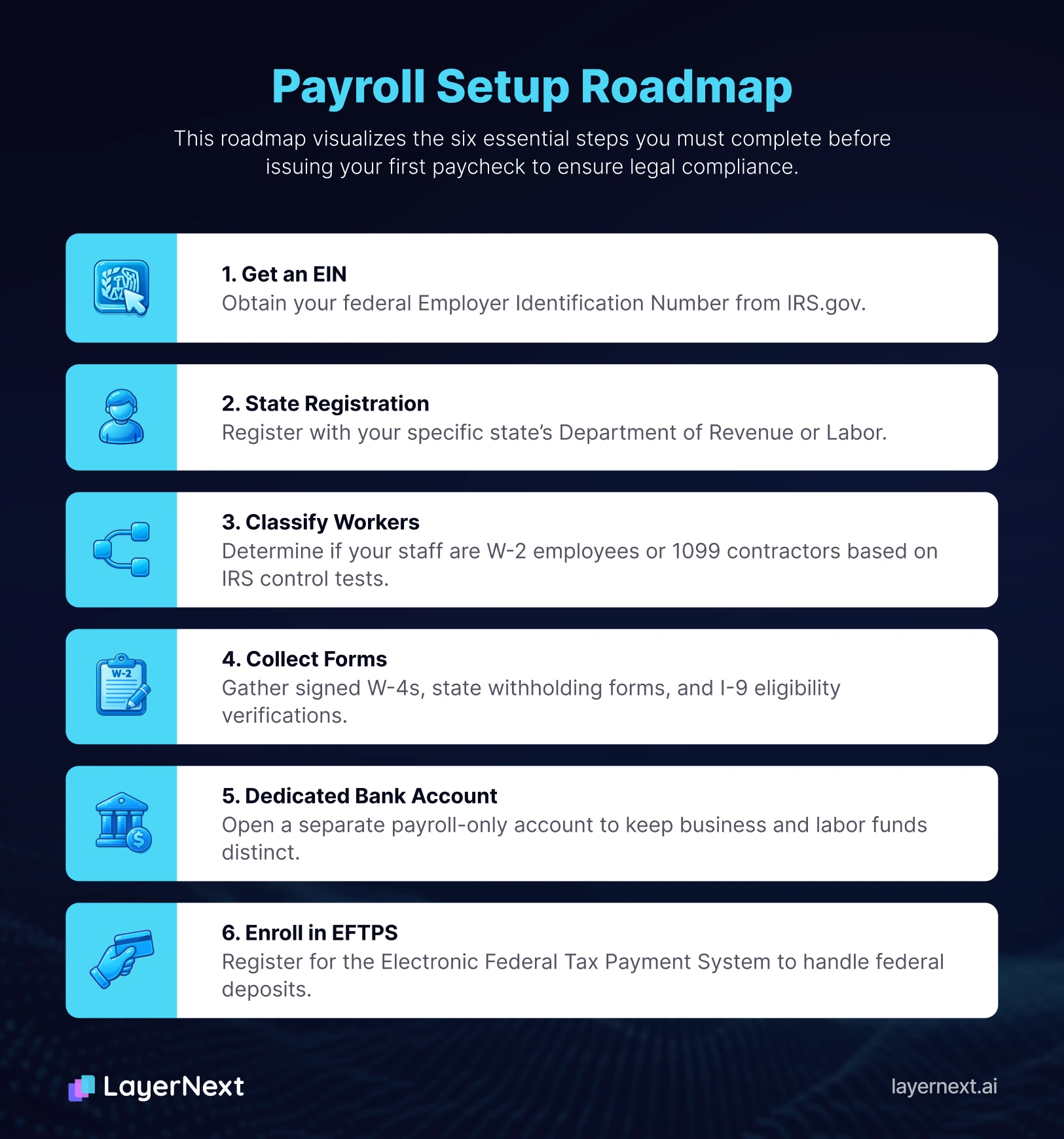
Get these five things in place before you process your first paycheck. Skipping any of them creates problems down the line.
1. Obtain an Employer Identification Number (EIN)
Your EIN is your business's tax ID, the federal government uses it to track your payroll tax deposits and filings. You cannot legally run payroll without one.
Apply for free at IRS.gov. You'll receive your EIN immediately after completing the online application.
2. Register with Your State Tax Agency
Most states require you to register as an employer before you can withhold and remit state income taxes and state unemployment taxes. Registration processes vary, check your state's Department of Revenue or Department of Labor website for specifics.
3. Classify Your Workers Correctly
This is one of the most penalized mistakes in small business payroll. Misclassifying an employee as an independent contractor can result in back taxes, penalties, and interest going back years.
The IRS uses a behavioral, financial, and relationship test to determine worker classification. The core question: does your business control how the work is done, or just the result? If you set someone's hours, provide their equipment, and direct their daily tasks, they are almost certainly an employee, not a contractor.
Review the IRS worker classification guidance if you're unsure.
4. Collect Required New-Hire Forms
Before an employee's first payday, you need three forms:
- W-4 (Federal Withholding Certificate) : Tells you how much federal income tax to withhold. Each employee completes this themselves based on their filing status and allowances.
- State withholding form : The state-level equivalent of the W-4. Most states have their own version.
- Form I-9 (Employment Eligibility Verification) : Required by federal law to verify that the employee is legally authorized to work in the United States. You do not file this with any agency, but you must keep it on file for three years after hire or one year after termination, whichever is later.
5. Set Up a Dedicated Payroll Bank Account
Running payroll from your general business checking account is a common mistake. A dedicated payroll account keeps your payroll funds separate, makes reconciliation easier, and creates a clear paper trail. Fund it before each pay run with the exact net pay and employer tax amounts you owe.
6. Enroll in EFTPS
The Electronic Federal Tax Payment System (EFTPS) is how you make federal payroll tax deposits. Enrollment is free at eftps.gov and takes about a week for your PIN to arrive by mail, so register before you need to make your first deposit.
2026 Payroll Compliance Checklist
Use this checklist when onboarding your first employee or auditing your existing process. Print it out or save it somewhere accessible.
One-Time Setup
- EIN obtained from IRS.gov
- State employer registration complete
- EFTPS enrollment confirmed (PIN received by mail)
- Dedicated payroll bank account open
- Payroll software or provider selected and configured
Each New Hire
- W-4 (federal) collected and filed
- State withholding form collected and filed
- Form I-9 completed and stored (not filed; kept on site)
- Worker classification confirmed (W-2 employee vs. 1099 contractor)
- Employee added to payroll system with correct pay rate, pay period, and direct deposit info
Each Pay Run
- Hours verified (hourly employees) or salary confirmed (salaried employees)
- Overtime calculated on a weekly basis (not bi-weekly)
- Pre-tax deductions applied (401k, health insurance, HSA/FSA)
- Federal and state tax withholdings calculated using current 2026 tables
- Post-tax deductions applied (garnishments, Roth 401k)
- Net pay confirmed and direct deposit/checks processed
- Pay stubs provided to all employees
Each Deposit Deadline
- Federal taxes deposited via EFTPS by your assigned schedule (monthly or semi-weekly)
- State taxes deposited per your state's schedule
- FUTA deposit made if quarterly liability exceeds $500
Quarterly
- Form 941 filed by the due date for the quarter
- Payroll records reconciled
Annual
- W-2s issued to all employees by January 31
- 1099-NECs issued to contractors paid $600+ by January 31
- Form 940 (FUTA) filed by January 31
- Withholding tables updated to the new year's figures
- Social Security wage base updated ($184,500 for 2026)
How to Calculate Payroll: Step by Step
Once your setup is complete, here's exactly how to calculate each employee's paycheck.
Step 1: Calculate Gross Pay
Hourly employees: Multiply hours worked by the hourly rate. Include overtime, under the Fair Labor Standards Act (FLSA), non-exempt employees must be paid at least 1.5x their regular rate for hours worked over 40 in a workweek. Review the DOL FLSA overview for overtime rules.
Salaried employees: Divide annual salary by the number of pay periods. A $52,000/year employee on a bi-weekly schedule earns $2,000 gross per paycheck.
Step 2: Subtract Pre-Tax Deductions
Pre-tax deductions reduce the amount of income subject to federal (and often state) income tax. Common pre-tax deductions include:
- Health insurance premiums (employee share)
- 401(k) or 403(b) contributions
- Health Savings Account (HSA) contributions
- Flexible Spending Account (FSA) contributions
- Commuter benefits
For example, if an employee earns $2,000 gross and contributes $200 to their 401(k) and $100 toward health insurance, their taxable wages for income tax purposes drop to $1,700. However, FICA taxes are still calculated on the full $2,000 (with the exception of Section 125 cafeteria plan deductions).
Step 3: Calculate Federal Tax Withholdings
You'll withhold three federal taxes from every employee's paycheck:
Federal Income Tax : Determined by the employee's W-4 and the IRS withholding tables in Publication 15-T (2026). The amount depends on their filing status, pay frequency, and taxable wages.
Social Security Tax : 6.2% of gross wages, up to the 2026 Social Security wage base of $184,500. You also pay 6.2% as the employer.
Medicare Tax : 1.45% of all gross wages with no wage cap. You also pay 1.45% as the employer. Employees earning over $200,000 in a year are subject to an additional 0.9% Additional Medicare Tax, which you withhold but do not match.
Step 4: Calculate State and Local Taxes
State income tax withholding varies widely. Some states (like Texas, Florida, and Washington) have no income tax. Others have flat rates or progressive brackets. Check your state's withholding tables for the correct amount.
Some localities, particularly cities like New York City and Philadelphia — also impose local income taxes that you must withhold.
Step 5: Subtract Post-Tax Deductions
Post-tax deductions come out after all taxes are calculated. These include:
- Wage garnishments (child support, tax levies, student loan garnishments)
- Roth 401(k) contributions (taxed before going in)
- Life insurance premiums above $50,000 in coverage
- Voluntary deductions the employee has requested
Step 6: Arrive at Net Pay
Net Pay = Gross Pay − Pre-Tax Deductions − All Tax Withholdings − Post-Tax Deductions
That final number is what you deposit into the employee's bank account or put on their check.
Worked Example: Calculating One Paycheck
Here's a complete calculation for a real-world scenario so you can see every step in action.
Employee: Sarah, full-time salaried
Annual salary: $52,000
Pay schedule: Bi-weekly (26 pay periods)
Filing status: Single, no adjustments on W-4
Pre-tax deductions: $200/period to 401(k), $100/period toward health insurance premium
Post-tax deductions: None
Step 1: Gross pay: $52,000 ÷ 26 = $2,000.00
Step 2: Pre-tax deductions: $200 (401k) + $100 (health) = $300 subtracted Taxable wages for income tax purposes: $2,000 − $300 = $1,700.00 (FICA is still calculated on full $2,000 gross)
Step 3: Federal withholdings (on $1,700 taxable wages):
- Federal income tax (from 2026 Publication 15-T, Single, bi-weekly): ~$147.00
- Social Security: $2,000 × 6.2% = $124.00
- Medicare: $2,000 × 1.45% = $29.00
Step 4: State tax (example: 5% flat rate): $1,700 × 5% = $85.00
Step 5: Post-tax deductions: $0
Net Pay: $2,000 − $300 − $147 − $124 − $29 − $85 = $1,315.00
Employer's additional costs per this paycheck:
- Employer Social Security: $2,000 × 6.2% = $124.00
- Employer Medicare: $2,000 × 1.45% = $29.00
- FUTA (until $7,000 YTD wage base met): $2,000 × 0.6% = $12.00
- SUTA (varies by state): varies
Total employer cost per paycheck: approximately $2,165.00 ($2,000 gross + $165 in employer taxes)
Quick-Reference: Federal Payroll Tax Rates at a Glance (2026)
*After applying the 5.4% state tax credit, assuming timely SUTA payments.
Paying and Depositing Payroll Taxes
Calculating taxes is only half the job. You also have to deposit them on time.
Federal Tax Deposit Schedule
The IRS assigns you a deposit schedule, either monthly or semi-weekly, based on your total tax liability from the prior lookback period (the 12-month period ending June 30 of the prior year).
- Monthly depositor: If your total tax liability during the lookback period was $50,000 or less, you deposit taxes by the 15th of the following month.
- Semi-weekly depositor: If your liability exceeds $50,000, you deposit more frequently. Payroll paid on Wednesday, Thursday, or Friday must be deposited by the following Wednesday. Payroll paid on Saturday through Tuesday must be deposited by the following Friday.
- Next-day rule: If you accumulate $100,000 or more in tax liability on any single day, you must deposit the next business day, regardless of your usual schedule.
All federal deposits are made through EFTPS.
Penalties for Late Deposits
The IRS failure-to-deposit penalty is tiered and adds up fast:
These penalties apply to the unpaid deposit amount, not your total payroll. Still, on a $10,000 deposit that's three weeks late, you're looking at a $1,000 penalty, before interest.
State Tax Deposits
Each state sets its own deposit schedule and payment method. Most have online portals. Deposit deadlines typically align with or follow your federal schedule, but confirm with your state's revenue agency.
Payroll Forms and Filing Deadlines
Running payroll generates ongoing filing obligations. Miss these and you face late filing penalties on top of any deposit penalties.
Form 941 - Quarterly Federal Payroll Tax Return
Filed four times a year, Form 941 reports the total wages paid, federal income tax withheld, and FICA taxes for each quarter. It reconciles what you deposited throughout the quarter with what you actually owed.
Form 940 - Annual FUTA Return
Filed once per year, due January 31. Reports your federal unemployment tax liability for the year and reconciles your deposits. If your FUTA liability at the end of any quarter exceeds $500, you must deposit it before year-end rather than waiting for the annual return.
W-2s - Wage and Tax Statements
You must provide each employee with their W-2 by January 31. You also file copies with the Social Security Administration by January 31. W-2s report annual wages and all taxes withheld.
1099-NEC - Nonemployee Compensation
If you paid an independent contractor $600 or more during the tax year, you must send them a 1099-NEC and file a copy with the IRS by January 31.
Annual Payroll Compliance Calendar (2026)
For the complete IRS payroll tax calendar, visit the IRS Employment Tax Due Dates page.
What to Do If You're Behind on Payroll Taxes
Falling behind on payroll tax deposits is one of the most stressful situations a small business owner can face, but it is also one of the most common. Here is how to handle it.
- Act immediately.
The failure-to-deposit penalty is tiered: the longer you wait, the higher the percentage. Even if you cannot pay the full balance immediately, deposit as much as you can right away. Every dollar deposited stops accruing the penalty from that point forward. - Do not use withheld employee taxes for other expenses.
This is known as "pyramiding" and is treated very seriously by the IRS. Withheld taxes are held in trust for employees; using them for operations can trigger personal liability under the Trust Fund Recovery Penalty, making you personally responsible for 100% of the unpaid taxes, even if your business is an LLC or corporation. - Request penalty abatement.
If you have a clean compliance history, the IRS offers First Time Abatement (FTA), which can waive the failure-to-deposit penalty for your first offense. Apply by calling the IRS or submitting Form 843. - Set up a payment plan.
If you cannot pay the full amount owed, the IRS Online Payment Agreement tool lets you apply for an installment arrangement. Interest continues to accrue, but a payment plan stops additional penalties from compounding. - Consult a payroll tax specialist or CPA.
If you are significantly behind (multiple quarters, multiple employees, or six-figure liability), get professional help before the IRS contacts you. Proactive resolution is almost always cheaper than reactive.
Payroll Methods: DIY vs. Software vs. Outsourcing
There's no single right answer here, the best method depends on your transaction volume, how much time you have, and your risk tolerance for compliance errors.
Manual payroll is technically possible with spreadsheets and the IRS withholding tables, but even a small calculation error compounds across multiple pay periods. Most accountants advise against it for anyone with more than one or two employees.
Payroll software like Gusto, QuickBooks Payroll, or Patriot Payroll automates withholding calculations, generates pay stubs, handles direct deposit, and often files your 941s automatically. Costs typically run $40–$80/month as a base fee plus $6–$12 per employee. For most small businesses, this is the right balance of cost and compliance protection.
Full-service payroll providers and PEOs handle everything including tax filings, year-end W-2s, and HR compliance. The cost is higher, but so is the peace of mind. Best suited for businesses with complex payroll needs, multiple states, or limited internal administrative capacity.
Common Payroll Mistakes Small Businesses Make
Knowing what can go wrong is half the battle. Here are the most frequent, and most costly payroll mistakes small business owners make.
- Misclassifying Employees as Contractors
Already mentioned in the setup section, but worth repeating: this is the IRS's most-penalized payroll offense. If an audit determines that someone you classified as a 1099 contractor should have been a W-2 employee, you owe back taxes for the employer share of FICA, plus penalties and interest, often going back three or more years. - Missing Tax Deposit Deadlines
The tiered penalty structure described above makes late deposits expensive very quickly. Set calendar reminders well in advance of every deposit due date, and don't rely on memory. - Miscalculating Overtime
The FLSA requires overtime pay (1.5x the regular rate) for non-exempt employees working more than 40 hours in a workweek. Common errors include calculating overtime on a bi-weekly basis instead of weekly (incorrect), failing to include bonuses in the regular rate calculation, and misclassifying non-exempt employees as exempt. - Failing to Update Tax Tables Annually
Federal and state tax withholding tables change every year. The 2026 Social Security wage base increased to $184,500, up from $176,100 in 2025. Using the prior year's figures results in under-withholding, which means your employees face surprise tax bills, and you may owe corrections. Update your payroll software at the start of each year. - Poor Recordkeeping
The IRS requires you to keep payroll records, including W-4s, pay stubs, timesheets, and tax deposit records, for at least four years. Poor records make audits far more painful and expensive than they need to be. - Ignoring State-Specific Rules
Minimum wage, paid sick leave mandates, final paycheck timing, and state unemployment tax rates all vary by state and change regularly. If you have remote employees working in different states, you may have multi-state payroll obligations that require separate state registrations.
Payroll for Special Situations
Paying Yourself as an Owner
How you pay yourself depends on your business structure:
- Sole proprietor / single-member LLC: You take an owner's draw, not a paycheck. You don't run payroll for yourself, but you pay self-employment tax (15.3%) on your net business income via quarterly estimated payments.
- S-Corporation owner: The IRS requires S-corp owners who work in the business to pay themselves a "reasonable salary" through payroll. You then run payroll for yourself, withhold taxes, and can take additional distributions beyond your salary.
- C-Corporation owner: You are an employee of your corporation and must be on payroll with all applicable withholdings.
Getting this wrong, particularly underpaying S-corp salaries to avoid payroll taxes, is a well-known IRS audit trigger.
Handling Tipped Employees
Employers of tipped workers (restaurants, hospitality) must ensure that tips plus the cash wage equal at least the federal minimum wage for all hours worked. You must also withhold taxes on reported tips and may be responsible for FICA on allocated tips. The IRS has specific guidance on tip reporting that differs from standard payroll.
Multi-State Payroll
If you have employees working remotely in different states, you likely have tax obligations in each state where an employee works, not just where your business is based. This means multiple state registrations, multiple withholding requirements, and potentially multiple SUTA accounts. Payroll software with multi-state support is strongly recommended in this scenario.
Seasonal or Part-Time Employees
The same payroll rules apply to seasonal and part-time workers as to full-time employees. The only difference is that their hours and pay amounts vary. You still withhold taxes based on their W-4 and gross pay for each period, there is no "part-time exemption" from payroll tax obligations.
The Bottom Line
Payroll has more moving pieces than most small business owners expect, but none of it is beyond your reach. The process breaks down into a logical sequence: set up correctly, calculate accurately, deposit on time, and file on schedule. Get those four things right and you'll avoid the vast majority of payroll problems that cost small businesses time and money.
The areas that trip people up most are classification errors, missed deposit deadlines, and stale tax tables, particularly important in 2026 given the Social Security wage base jumped from $176,100 to $184,500. Build reminders into your calendar, invest in payroll software if you have more than one or two employees, and keep your books clean so you always know where you stand financially.
If you're handling payroll through Gusto, QuickBooks Payroll, or any other platform, pair it with LayerNext to make sure every payroll run flows accurately into your books, automatically, in real time, without manual effort.
Ready to keep your books as clean as your payroll? Start your free 7-day LayerNext trial at layernext.ai, no credit card required.
Frequently Asked Questions