Summary
The article explains the IRS mileage rates for 2025 and 2026, who can claim them, and how to use them correctly to maximize deductions. It breaks down the rates for business, medical, charitable, and military moving purposes, clarifies that self-employed individuals and business owners benefit most from the business mileage deduction, and warns that commuting miles are never deductible. It also compares the standard mileage method vs. actual expense method, shows how to calculate deductions, and stresses that a detailed mileage log is essential to stay compliant and audit-ready.
- 2025 vs. 2026 rates: Business mileage increased from $0.70 to $0.725 per mile, while medical and military moving dropped slightly to $0.205; charitable stays at $0.14.
- Best fit for business owners: Self-employed workers, freelancers, and small business owners can often claim valuable vehicle deductions for qualified business travel.
- Commuting does not count: Miles driven from home to a regular workplace are personal commuting miles and are not deductible.
- Choose your deduction method carefully: The standard mileage rate is simpler, while the actual expense method may save more for high-cost vehicles or lower-mileage use cases.
- Documentation matters: To claim the deduction safely, keep a contemporaneous mileage log with the date, destination, purpose, and miles for each trip.
Tax season is here, and if you drove for your business in 2025, every mile you logged has a real dollar value on your return. At the same time, if you're driving for business right now in 2026, the rate just went up and you'll want to know exactly what you can claim.
The IRS sets a standard mileage rate each year that determines how much you can deduct per mile driven for business, medical, or charitable purposes. Miss it, or miscalculate it, and you're leaving money on the table.
This guide covers the official IRS mileage rates for both 2025 and 2026, who qualifies, which deduction method saves you the most, and how to track miles the right way so you're always audit-ready.
What Is the IRS Standard Mileage Rate?
The IRS standard mileage rate is a fixed cents-per-mile figure published annually. Instead of tracking every fuel receipt, oil change, and insurance payment, you multiply your total qualifying miles by the rate and claim that as your deduction. Simple, clean, and IRS-approved.
The rate is calculated based on the average cost of owning and operating a vehicle in the US fuel, depreciation, insurance, and maintenance all factored in. It's reviewed every year and occasionally adjusted mid-year when costs shift significantly.
These rates apply to gasoline, diesel, hybrid, and fully electric vehicles. The IRS does not create separate mileage rates by fuel type. IRS
IRS Mileage Rates for 2025 and 2026
Here's the full picture side by side:
The 2026 business rate of $0.725/mile is an increase of 2.5 cents from the 2025 mileage rate, while the medical and moving rate decreased by half a cent. (Driversnote) The increase in the business rate reflects higher long-term vehicle ownership costs insurance premiums, repair costs, vehicle prices, and depreciation trends all play a role. (IRS)
Who Qualifies for the Business Mileage Deduction?
Not everyone can claim this, it depends on how you're classified for tax purposes.
1. Self-employed individuals and freelancers
File a Schedule C? You can deduct business mileage. This covers consultants, contractors, gig workers, real estate agents, and anyone running their own business.
2. Small business owners
Using a personal vehicle for client visits, supply runs, or job sites? Those miles are deductible.
3. W-2 employees
Most W-2 employees cannot deduct unreimbursed mileage due to current tax law IRS, a rule that's been in place since the 2018 Tax Cuts and Jobs Act. If your employer doesn't reimburse you, those miles are unfortunately not deductible at the federal level.
4. Electric vehicle owners
The IRS mileage rates are the same for all types of cars, including internal combustion engine, hybrid, and electric vehicles. Pinion Global You can use the same standard rate regardless of what you drive.
One critical exclusion
Commuting miles driving from your home to your regular workplace are never deductible, no matter the distance. This is one of the most common and costly mistakes small business owners make.
Business Mileage Rate: Who Qualifies and What It Covers
The business mileage rate is the one most small business owners and self-employed individuals care about, and for good reason. At $0.725 cents per mile in 2026, it's the most valuable of the three categories.
Who can use it:
- Self-employed individuals filing Schedule C freelancers, consultants, contractors, gig workers, real estate agents
- Small business owners using a personal vehicle for business purposes
- Partnership members and certain S-corp shareholders driving for business
Who cannot use it:
The business standard mileage rate cannot be used to claim an itemized deduction for unreimbursed employee travel expenses. (Natptax) This rule has been in place since the 2018 Tax Cuts and Jobs Act and was made permanent under the One Big Beautiful Bill. If you're a W-2 employee whose employer doesn't reimburse mileage, those miles are not deductible at the federal level.
What counts as business mileage:
- Driving to client meetings, job sites, or customer locations
- Travel between multiple work locations
- Supply runs and business errands
- Driving to a temporary work location
What does NOT count:
Commuting the drive from your home to your regular, fixed workplace is never deductible, no matter how far you travel. This is one of the most common and costly mistakes small business owners make on their returns.
The math
At $0.725/mile in 2026, driving 20,000 business miles equals a $14,500 deduction. At the 2025 rate of $0.70, that same driving was worth $14,000. The rate increase alone adds $500 to your deduction without driving a single extra mile.
Medical Mileage Rate: What Qualifies and How to Claim It
The medical mileage rate is more limited than the business rate, and fewer taxpayers qualify but if you do, it's worth claiming.
The medical mileage rate applies to qualifying travel related to medical care, and for most individuals, moving expenses are not deductible only active-duty military personnel can claim the moving rate. (HRWatchdog)
What qualifies for the medical mileage deduction:
- Driving to doctor appointments, hospital visits, or specialist consultations
- Travel to a pharmacy to pick up prescribed medication
- Trips to physical therapy, mental health appointments, or medical procedures
- Transportation for a dependent's qualifying medical care
Important limitation: Medical mileage is only deductible if you itemize deductions on Schedule A, and only to the extent your total medical expenses exceed 7.5% of your adjusted gross income (AGI). For many taxpayers, this threshold makes the deduction difficult to reach, but if you have significant medical expenses in a year, every mile counts.
At $0.205/mile for 2026 (down slightly from $0.21 in 2025), 2,000 qualifying medical miles equals a $410 deduction toward that threshold.
Charitable Mileage Rate: Volunteers and Nonprofit Driving
The charitable mileage rate is the lowest of the three, and unlike the business and medical rates, the rate for charitable use is not determined by the IRS's annual cost study but is set by statute under 170(i) Driversnote, meaning Congress would need to pass legislation to change it. That's why it has held steady at $0.14/mile for years.
What qualifies:
- Driving to and from a volunteer shift at a qualifying nonprofit or charity
- Travel to deliver goods, prepare meals, or provide services on behalf of a charitable organization
- Mileage driven as part of an organized volunteer program
What does not qualify:
- Driving to a charity event you're attending as a participant or donor (not as a volunteer)
- Travel for a political organization
- Mileage reimbursed by the organization
The charitable deduction is claimed on Schedule A under charitable contributions, so it's only available to taxpayers who itemize. At 14¢/mile, it's modest, but if you volunteer regularly throughout the year, those miles add up and deserve to be documented.
Standard Mileage vs. Actual Expense Method: Which Saves You More?
You have two options for deducting vehicle costs, and you generally need to choose one in the first year you use the vehicle for business.
Standard Mileage Method
Multiply total business miles by the IRS rate. That's your deduction. Requires only a mileage log.
Actual Expense Method
Track and deduct the real costs of operating your vehicle: fuel, insurance, registration, repairs, depreciation proportional to your business use percentage. The mileage rate includes all incremental costs of operating a vehicle gas, maintenance, oil, tires, repairs, insurance, registration fees, and depreciation. It does not include the cost of parking and tolls.
Side-by-side example (2025 numbers)
Key rules on switching methods:
- Taxpayers using the standard mileage rate for a vehicle they own and use for business must choose to use the rate in the first year the automobile is available for business use in later years, they can choose standard mileage or actual expenses. IRS
- For a leased vehicle, taxpayers using the standard mileage rate must employ that method for the entire lease period, including renewals. IRS
This is exactly where LayerNext helps.
Manually tracking fuel receipts, insurance bills, and maintenance logs across the year is tedious and easy to get wrong. LayerNext's AI CFO automatically categorizes all vehicle-related expenses as they happen, so when it comes time to compare methods, your numbers are already clean and ready. No scrambling at tax time.
How to Track Mileage for Taxes (The Right Way)
This is where most small business owners fall short. The IRS doesn't just want a total mileage number, they want documentation for every trip.
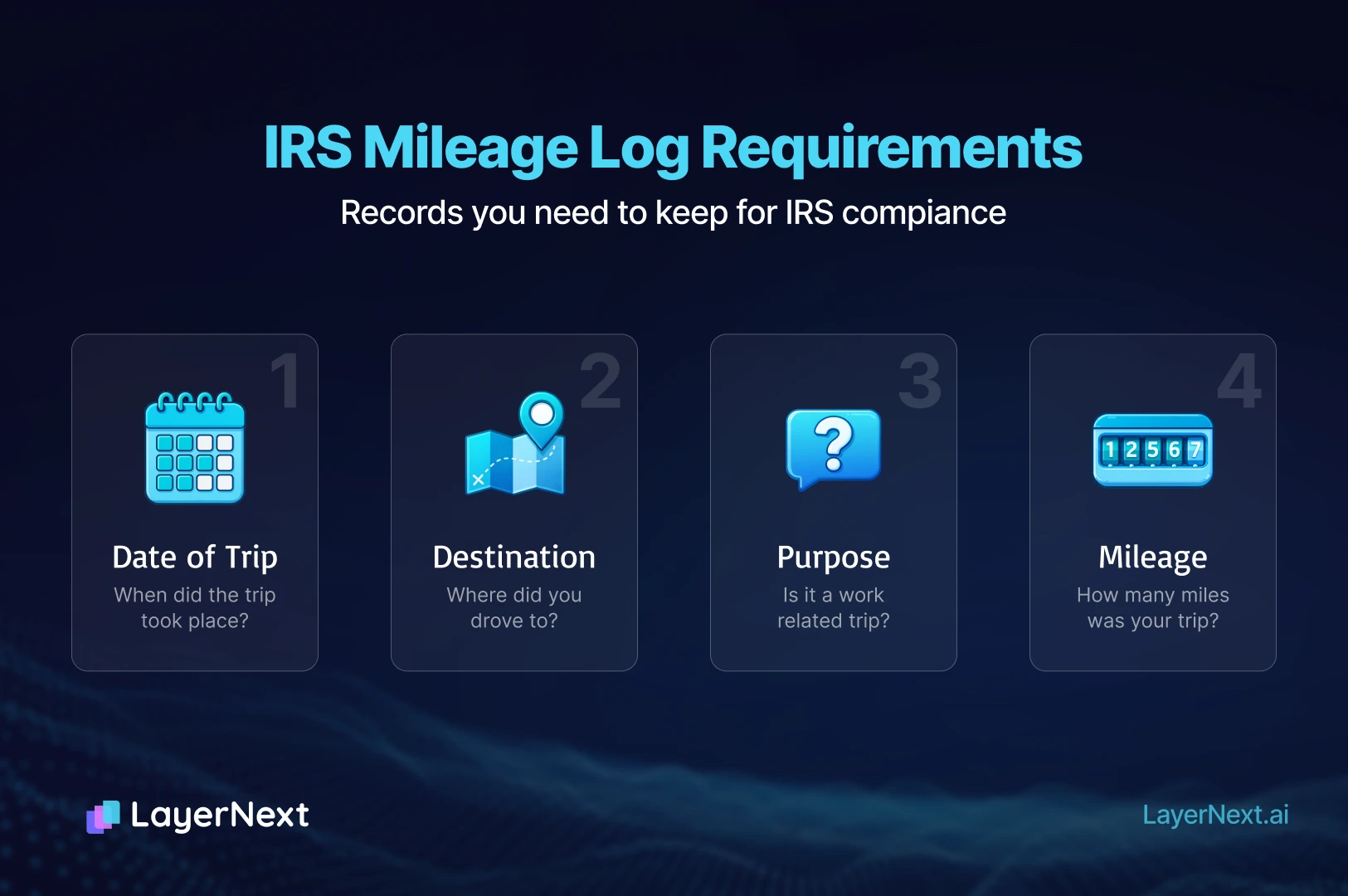
What your mileage log needs for each trip:
- Date of the trip
- Starting point and destination
- Business purpose
- Miles driven
A handwritten notebook works, but mileage tracking apps make this far easier and harder to lose. The key is logging trips in real time, not reconstructing them at year-end from memory.
What happens if you get audited without a log?
The IRS can disallow your entire mileage deduction, even if you genuinely drove those miles for business. No documentation = no deduction.
This is where LayerNext directly solves a real problem for small business owners. Rather than managing a separate mileage tracker, a receipt folder, and your QuickBooks entries in parallel, LayerNext's AI CFO keeps your books always closed automatically categorizing business expenses, reconciling transactions in real time, and keeping everything audit-ready without you lifting a finger. When your bookkeeping is automated, you can focus on logging miles knowing the financial side is already handled.
Where to Report Mileage on Your Tax Return
If you're using the actual expense method or claiming depreciation, you'll also need Form 4562.
Step-by-step calculation:
- Total your business miles for the year
- Multiply by the applicable rate ($0.70 for 2025, $0.725 for 2026)
- Enter the result as your vehicle expense deduction
Common mistakes to avoid:
- Including commuting miles in your business total
- Forgetting to track miles for short, frequent trips (client coffee meetings, bank runs these add up)
- Switching methods year-to-year without checking IRS rules
- Not keeping a contemporaneous log (reconstructed logs are a red flag in audits)
Stop Leaving Miles and Money on the Table
The IRS mileage deduction is one of the simplest, highest-value deductions available to small business owners and freelancers. At 70 cents per mile for 2025 and 72.5 cents for 2026, consistent tracking can add up to thousands of dollars in tax savings annually.
But the deduction only works if your books are clean, your records are organized, and your expenses are properly categorized. That's the part most business owners struggle with.
LayerNext takes that burden off your plate entirely. As your AI CFO, it automatically handles bookkeeping, reconciles your bank accounts in real time, and keeps your books always closed so every expense, including vehicle costs, is captured, categorized, and tax-ready without you doing any of the manual work.
Start for free at LayerNext
Frequently asked questions about IRS Mileage Rates
Always consult a qualified tax professional for advice specific to your situation. IRS rules on mileage deductions can vary based on your business structure, vehicle type, and usage.