
For small business owners and founders, the federal tax calendar is more than a list of deadlines; it is a roadmap for financial survival. Traditionally, tax season is a period of "bookkeeping chaos," characterized by missing bills, messy records, and excessive back-and-forth with accountants. However, as we look toward 2026, the emergence of AI CFO technology allows businesses to move away from reactive "month-end" scrambles toward a state of always-closed books.
By automating routine tasks like categorization and reconciliation, businesses can ensure they are not just meeting deadlines, but are strategically prepared for them year-round.
Staying ahead of the IRS requires tracking various forms and payment dates. Inspired by professional tax standards, here are the critical dates for the 2026 cycle.
Many founders manage their own books in software like QuickBooks but struggle to keep them updated, often leading to $500/month bookkeeping bills for services that still require constant manual input. Traditional bookkeepers often ask endless questions about months-old transactions, creating a lag that prevents clear financial insights.
LayerNext was built by engineers who "hate bookkeeping" to solve this specific problem. Instead of relying on human labor or "hybrid" teams, an AI CFO acts as a true autonomous agent, handling the "bookkeeping grind" so the internal team can focus on growth.
The goal of an AI CFO is to keep the books tax-ready at all times. This is achieved through three primary technological pillars:
1. Automated Document Capture
Instead of hoarding physical receipts, you can forward emails, snap photos, or upload files directly to the platform. Every expense, invoice, and receipt is automatically captured and matched to its corresponding transaction. This ensures that every deduction is recorded in real-time, preventing the "missing bill" syndrome that plagues tax season.
2. Real-Time Bank Reconciliation
By connecting live bank feeds or uploading statements, the AI matches every transaction with bank-grade security and accuracy. This eliminates the need for manual entry and spreadsheets, ensuring that your general ledger is a perfect reflection of your bank account at any given moment.
3. Agentic Autonomous Categorization
Unlike basic software, an AI-powered agentic system works autonomously from start to finish. If the system encounters missing information, it asks the business owner a clarifying question in plain English; once answered, it completes the task instantly. This keeps your books "always closed" without the typical month-end chaos.
Tax readiness is only half the battle. To run a business with confidence, founders need the deep financial clarity typically reserved for large corporations with full-time CFOs. Automation provides instant access to:
• Cash Flow Health: Knowing exactly how much liquid capital is available.
• Burn Rate and Runway: Understanding how long your current funds will last at current spending levels.
• Margin Analysis: Detailed reporting on the profitability of your products or services.
• Smart Tax-Saving Tips: Insights derived from spending patterns to maximize legal deductions.
Rather than waiting weeks for a report, you can simply ask a question in plain English and generate the necessary financial report on demand.
A modern financial stack must be both secure and integrated. AI CFO tools use bank-grade encryption to ensure data is never shared with third parties.
Furthermore, these systems do not replace your existing accounting software but rather enhance it. LayerNext, for example, syncs with QuickBooks in seconds, automating the work inside the platform you already use. This ensures that while the manual work is eliminated, the formal record remains in a standard general ledger (with integrations for Xero and Sage currently in development).
It is important to note that AI replaces the bookkeeping labor, not the accountant. You will still require a professional for complex filings and high-level tax strategy. However, because your books are always reconciled and clean, your accountant’s job becomes faster, cheaper, and simpler, allowing them to provide higher-value advisory services rather than fixing "messy" books.
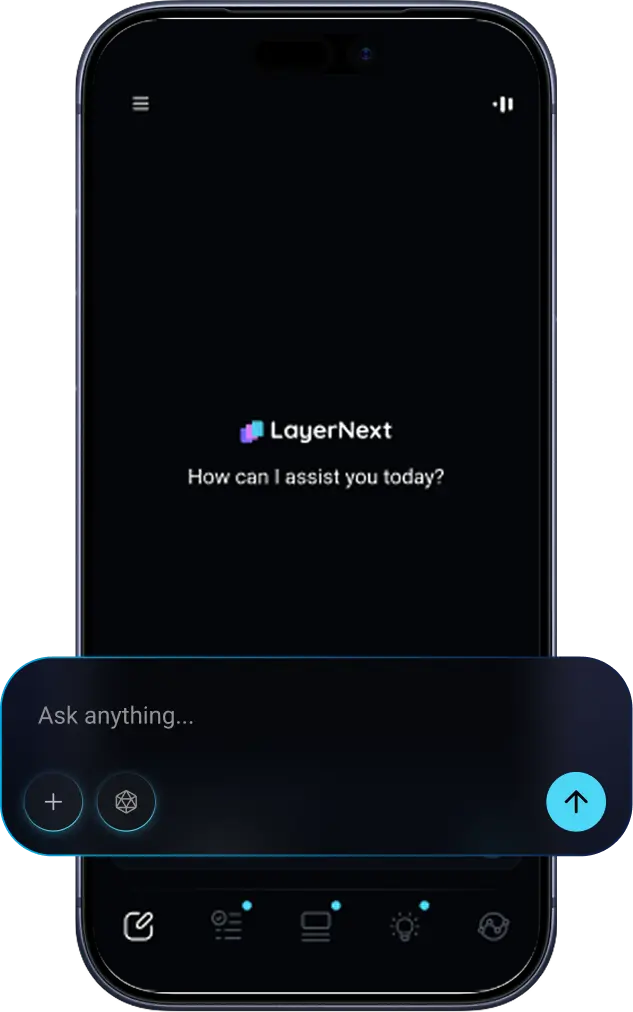
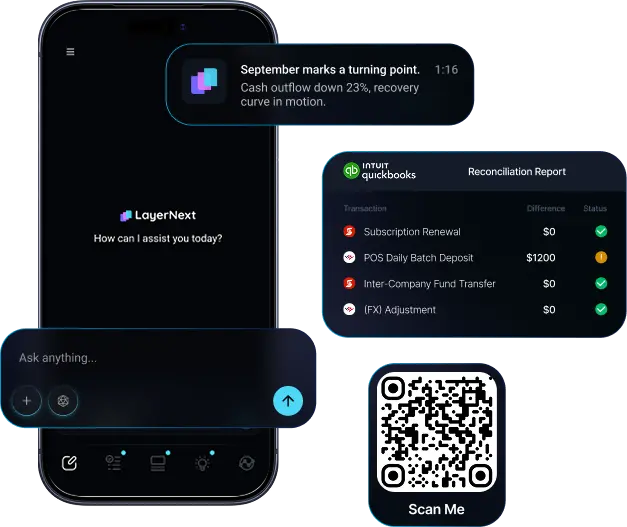
Your AI CFO for QuickBooks, Now on iOS and Android