Close
Back

What Is an AI CFO - And Does Your Small Business Actually Need One?

Sumudu Dinushika
February 26, 2026

Summary

An AI CFO isn’t just a chatbot; it’s an autonomous system that handles the grunt work of a bookkeeper while providing the high-level strategy of a $150k executive. It moves you from reactive recording to proactive planning.

The Essentials

  • What it does: Automates receipt matching, daily bank reconciliation, and real-time cash flow forecasting.
  • Who it’s for: Businesses earning $100k–$2M that need financial clarity but can't justify a $3k–$10k/month fractional CFO.
  • The Benefit: You stop "flying blind." You’ll know your exact burn rate, margins, and runway every day. Not just at tax time.

The Reality Check

It replaces manual data entry and basic financial analysis, but you still need an accountant for tax filing and your own judgment for big-picture pivots.

At some point, maybe during tax season, maybe when your accountant asked a question you couldn't answer, maybe when you checked your bank balance and felt that familiar sinking feeling you realized something.

You're making real financial decisions without real financial clarity.

Pricing your services on gut feel. Hiring without knowing your actual margins. Finding out cash is tight only after it already is. Running a business you worked incredibly hard to build, but never quite knowing where you actually stand financially.

That's not a personal failing. That's what happens when you're running a business without a CFO, which describes the overwhelming majority of small business owners, because a real CFO costs $150,000 to $300,000 a year and that's simply not a realistic option when you're bootstrapped.

An AI CFO changes that equation entirely. But before we get into whether your business actually needs one, let's get clear on what the role is really supposed to do because most people conflate it with bookkeeping and they're not the same thing at all.

What a Traditional CFO Actually Does (And Why It Matters)

A CFO is not an accountant. This is the most important distinction to understand before anything else.

Your accountant records what happened. They take your financial data, organize it, and file it correctly. They're working in the past categorizing last month's expenses, preparing last year's tax return, and reconciling what already occurred.

A CFO uses that data to drive what happens next. They're working in the present and the future analyzing your cash position right now, forecasting where it'll be in 90 days, identifying which parts of your business are actually profitable and which ones are quietly bleeding you out.

Specifically, a CFO handles cash flow management and forecasting, burn rate and runway analysis, financial reporting that informs decisions rather than just compliance, margin analysis by product or service line, strategic financial planning for pricing and growth, and risk management spotting financial problems before they become crises.

According to Bureau of Labor Statistics data, the median annual salary for a Chief Financial Officer in the US is well over $150,000 and that's before benefits, bonuses, and the reality that a good CFO at a growing company commands significantly more.

A fractional CFO, someone who works part-time across multiple businesses, runs $3,000 to $10,000 a month. Still out of reach for most bootstrapped founders.

So the vast majority of small business owners make major financial decisions when to hire, how to price, whether to expand without the clarity a CFO would provide. They're flying blind and calling it running lean.

That's the gap an AI CFO was built to close.

What Is an AI CFO - In Plain English

An AI CFO is not a chatbot that answers financial questions. It's not a dashboard you manually update once a month. It's not a smarter version of the spreadsheet you've been maintaining since year one.

It's an autonomous system that runs continuously in the background of your business handling the operational financial work that used to require a human bookkeeper, and delivering the strategic financial clarity that used to require a human CFO.

Here's what that looks like day to day:

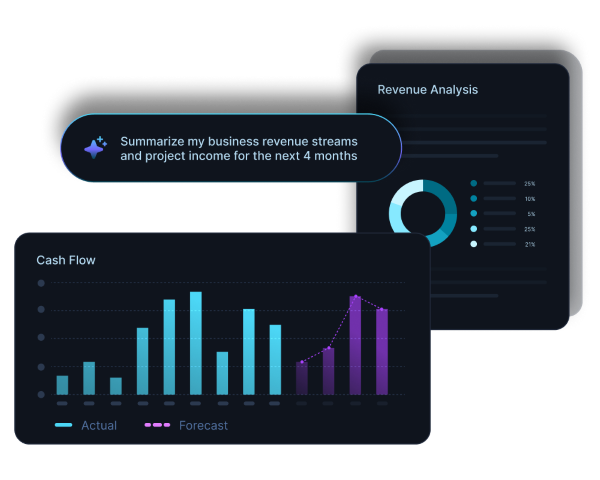
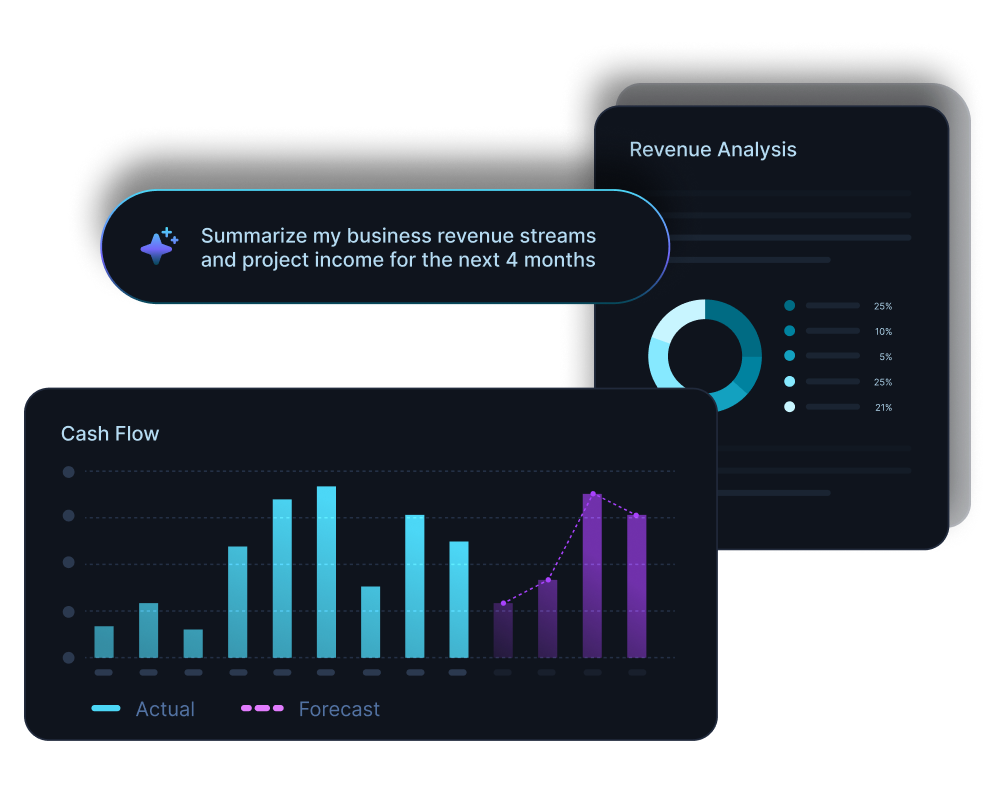
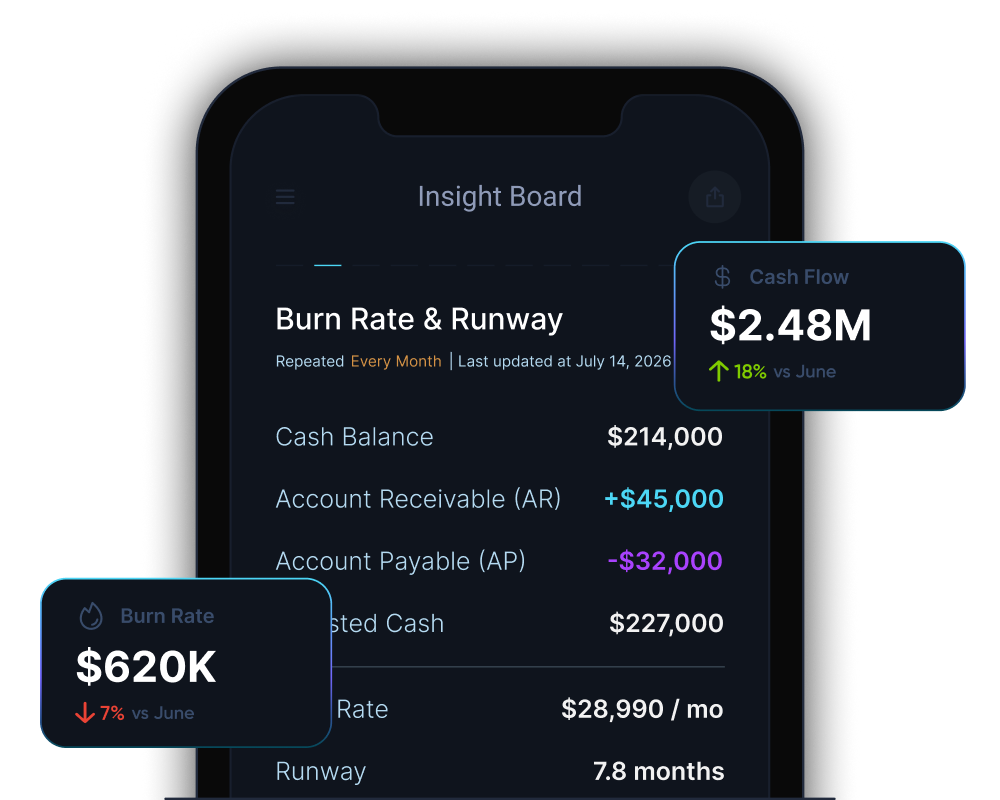
Every transaction that hits your bank account gets categorized automatically inside your accounting software before you even log in. Every receipt you forward by email or photograph through a mobile app gets matched to the corresponding transaction without you touching anything. Your bank accounts reconcile daily rather than in a monthly scramble. And on top of all of that, you get real-time visibility into your cash flow, burn rate, runway, and margins not as a report you have to generate, but as a live picture of your business that's always current.

The key distinction from regular bookkeeping software is this: QuickBooks organizes your financial data. An AI CFO acts on it, interprets it, and gives it back to you as something you can actually use to run your business better.

If you want to understand exactly how the automation side of this works inside QuickBooks, this step-by-step guide covers it completely.

The Honest Answer - Does Your Small Business Actually Need One?

Here's where most posts on this topic get vague and unhelpful. So let's be direct.

You probably need an AI CFO if:

You're running your own books in QuickBooks and spending 10 or more hours a month on it. You've been surprised by your cash position meaning you didn't know money was getting tight until it already was. Your books are regularly more than two weeks behind. You're making pricing or hiring decisions without clear margin data to back them up. You're paying a bookkeeper but still don't feel financially clear or in control. Tax season catches you off guard every single year. You have no idea what your burn rate or runway looks like right now. You're a Canadian business approaching or past $30,000 in revenue and haven't fully sorted your GST/HST tracking yet.

If three or more of those hit close to home, an AI CFO isn't a luxury. It's the most practical financial decision you can make right now.

You might genuinely not need one yet if:

You're pre-revenue or in the very earliest stage of building something a simple spreadsheet might be entirely sufficient at this point. You already have a bookkeeper and a fractional CFO working well together and the system is running smoothly. Your business has fewer than 20 transactions a month and the manual work is genuinely minimal.

The revenue sweet spot:

Most small business owners between $100,000 and $2,000,000 in annual revenue are exactly the right fit for an AI CFO. You're too big to ignore financial clarity the stakes are real and the decisions are consequential. But you're too small to justify a human CFO or even a mid-tier fractional arrangement. That's precisely the gap an AI CFO fills.

AI CFO vs. The Alternatives - An Honest Comparison

Let's look at your actual options side by side not to make competitors look bad, but because this is a real decision with real tradeoffs and you deserve a straight answer.

Option Monthly Cost What You Get What You Don't Get
Do it yourself $0 + 10–15 hrs/month Full control Time, accuracy, real-time clarity
Bookkeeper $400–$800 Someone else does data entry Strategic insights, still slow turnaround
Fractional CFO $3,000–$10,000 Strategic financial guidance Affordability for most SMBs
AI CFO (LayerNext) Fraction of the above Autonomous books + CFO-level insights Human relationship, complex tax strategy

Doing it yourself works until it doesn't. The hidden cost is never just the hours  it's the compounding errors you don't catch, the deductions you miss because your categorization wasn't quite right, and the mental load of knowing your books are always a little bit behind. For a business doing real revenue, this stops being a viable option faster than most people admit.

A bookkeeper solves the data entry problem but not the insights problem. Your books get cleaner, which is genuinely valuable but you're still flying blind strategically. You still don't know your burn rate. You're still finding out your cash position after the fact. And you're still answering receipt requests every other week. For many small business owners, the question of when to hire a CFO comes precisely because a bookkeeper alone isn't giving them what they need.

A fractional CFO is genuinely valuable at the right stage  if you're raising investment, navigating a complex financial decision, or scaling past $2M–$3M revenue. But at $3,000 to $10,000 a month it's simply inaccessible for most bootstrapped founders, and for most businesses under $1M it's more firepower than you need right now.

An AI CFO fills the gap between bookkeeper and fractional CFO. It handles all the operational work a bookkeeper would do autonomously, without the back-and-forth and adds the strategic financial clarity that a bookkeeper can't provide. For businesses in the $100K–$2M range, it's the option that makes the most financial sense on almost every dimension.

What Changes When You Have an AI CFO

The difference isn't just operational. It changes how you experience running your business.

Before an AI CFO

You find out your cash is getting tight when you check your bank balance and feel that familiar knot in your stomach. Month-end is a thing you dread a multi-hour scramble to reconcile what should have been tracked all along. Your accountant asks for records you have to dig through emails to find. You price your services based on what feels right, not what your margins actually support. Tax season is always a scramble, always a surprise, always a few receipts short of what you need.

After an AI CFO

You know your cash position, burn rate, and runway right now, not last month, not last quarter. Right now. Month-end is just another day because your books are always closed there's no scramble because the reconciliation happened daily. Your accountant gets clean, current records without you doing anything to prepare them. You can see which services are actually profitable and make pricing decisions with real data behind them. Tax season is just filing the documentation that was organized automatically every single day of the year.

That last one is worth pausing on. The anxiety of not knowing where you stand financially is one of the most common and least talked about stressors of running a small business. An AI CFO doesn't just save you time. It removes something that's been sitting in the background of your mind for months.

What an AI CFO Doesn't Replace

This is worth being straight about, because overpromising helps nobody.

An AI CFO doesn't replace your accountant. You still need a qualified accountant for tax filing, CRA or IRS compliance, audit support, and accounting system setup and configuration. What changes is that your accountant shows up to a clean, organized set of books instead of spending the first three hours of every engagement untangling your records. Their work gets better. Your bill goes down. The relationship becomes more valuable because it's focused on the right things.

An AI CFO doesn't replace your business judgment. The system surfaces the data, the cash flow picture, the spending anomaly, the margin gap in one service line but you make the call. The AI gives you clarity. What you do with that clarity is still entirely yours.

An AI CFO doesn't replace a fractional CFO if you're navigating genuinely complex strategic financial decisions raising a round, going through a merger or acquisition, restructuring your business model. At that stage, human expertise and relationships matter in ways that software can't replicate.

As AICPA notes, the role of professional accountants in small business financial health remains significant particularly for compliance, tax strategy, and complex financial planning. An AI CFO makes that human expertise more accessible by ensuring the foundational work is always done.

The way to think about it: an AI CFO handles the financial operations so that when you do engage your accountant or an advisor, you're showing up with real clarity instead of a mess to sort through first.

Common Questions About AI CFOs

1. What is an AI CFO?

An autonomous software system that handles bookkeeping, bank reconciliation, and financial reporting automatically and delivers CFO-level insights like cash flow forecasting, burn rate analysis, and margin reporting in real time. It runs continuously in the background without manual input.

2. Is an AI CFO the same as an accountant?

No. An accountant records and files historical financial data. An AI CFO operates continuously, manages your books autonomously day to day, and gives you forward-looking financial clarity cash forecasts, burn rate, runway that goes well beyond what an accountant provides.

3. How much does an AI CFO cost?

Traditional CFOs cost $150,000 to $300,000 a year. Fractional CFOs run $3,000 to $10,000 a month. AI CFO tools like LayerNext cost a fraction of either; you can see the full breakdown at layernext.ai/pricing

4. Do small businesses actually need a CFO?

Not a traditional one, the cost makes it impossible for most. But the financial clarity a CFO provides? Every business needs that. An AI CFO makes CFO-level insight accessible regardless of size or budget.

5. Can an AI CFO replace my bookkeeper?

For most small businesses, yes it handles everything a bookkeeper does autonomously and adds strategic financial intelligence on top. The best AI bookkeeping tools for 2026 all operate on this principle.

6. What's the difference between AI bookkeeping and an AI CFO?

AI bookkeeping automates the data entry and organization. An AI CFO does that and uses the data to give you strategic financial intelligence: cash flow forecasting, burn rate, runway, and margin analysis. It's the difference between organized books and genuinely useful books.

7. Is an AI CFO right for a Canadian small business?

Absolutely and the Canadian context adds another layer of value. GST/HST tracking, CRA compliance, and Input Tax Credit management are all handled automatically. If you want the full picture on what that looks like, this guide covers CRA-compliant automated bookkeeping in detail.

The Bottom Line

You don't need a $200,000 CFO. But you do need what a CFO gives you real-time financial clarity, always-current books, and the confidence to make decisions without flying blind on numbers that are two months out of date.

For years, that clarity was only available to businesses that could afford a full-time finance team. That's no longer true.

LayerNext is an AI CFO built specifically for bootstrapped small business owners, the ones who are brilliant at running their business and have been quietly dealing with the financial side on borrowed time. It connects to your existing QuickBooks account, handles everything autonomously, and gives you the financial picture that used to cost $150,000 a year to access.

Your books stay closed. Your numbers stay current. And the low-grade financial anxiety that's been running in the background of your business, the one you've normalized so thoroughly you barely notice it anymore, finally goes quiet.

Ready to find out what always-closed books actually feel like?
Start for Free