Summary
Most small business owners are stuck managing QuickBooks manually, spending 10 to 15 hours per month on bookkeeping that is always a month behind. An AI CFO changes that by automating the entire financial operations function, from transaction categorization to real-time CFO-level insights, at a price that fits a small business budget.
What an AI CFO does for small businesses:
- Automates every transaction — categorized instantly, no manual entry
- Reconciles your bank accounts through QuickBooks or manual statement uploads
- Keeps your books always closed — current to today, not last month
- Delivers real-time burn rate, runway, and cash flow visibility
- Surfaces tax-saving tips continuously, not just at filing time
The impact:
- Time: Saves 15 or more hours per month, two full workdays back every month
- Money: Saves $5,000 to $32,000 per year vs a bookkeeper, depending on your plan
- Accountant: Your accountant stays, but their bill drops because they receive always-clean books instead of a mess to fix
Most small business owners are managing their finances one of three ways. They are doing it themselves manually in QuickBooks every weekend. They are paying a bookkeeper $500 to $2,000 per month for monthly reports that are already outdated. Or they are ignoring it entirely until tax season forces them to deal with it.
None of these work once the business starts growing.
The manual approach costs 10 to 15 hours per month of founder time. The bookkeeper approach costs thousands but still delivers no real-time visibility. And flying blind on cash flow and runway is how good businesses fail for entirely avoidable reasons.
There is a fourth option. An AI CFO gives small businesses the financial intelligence that used to require a full finance team, at a price that actually fits a small business budget. This article explains exactly what that means, what it costs, and whether it is right for your business.
What Is an AI CFO for Small Business?
Small business CFO software in this category does not replicate a human CFO. It replaces the operational finance work that currently falls on the founder: transaction categorization, bank reconciliation, month-end close, and financial reporting.
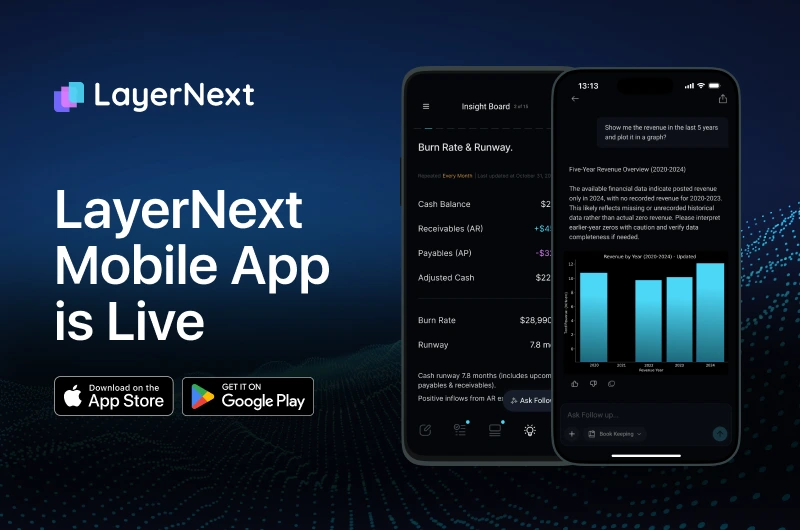
Every transaction that enters your QuickBooks account is categorized automatically. Your accounts reconcile continuously. Your books close themselves. Real-time visibility into cash position, burn rate, and runway is available the moment you open the app, not three weeks after the month ends.
For small businesses specifically, an AI CFO fills the gap between two stages most founders know well.
Stage 1: The founder manages everything manually in QuickBooks.
This works at low transaction volume. It stops working somewhere between $200K and $2M in annual revenue, when the volume and complexity outpace one person doing it in their spare time.
Stage 2: The business is large enough to justify a full-time finance hire.
A VP of Finance or controller makes sense at scale. It does not make sense at $800K ARR when the entire finance function is categorizing expenses and running monthly reports.
The gap between these two stages is where an AI CFO for small business delivers the most value.
Why Small Businesses Benefit More Than Large Companies
AI CFO tools are not enterprise software scaled down. They were built specifically for the SMB gap, and small businesses actually benefit from them more than large companies do.
Large companies have finance teams. Small businesses have founders.
A Series B startup has a VP of Finance, a controller, and two analysts. A $500K revenue small business has the founder managing QuickBooks on Sunday evenings. An AI CFO replaces the entire finance operations function for a small business, not just one role.
Small businesses cannot afford to work from stale data.
A large company can survive on monthly reports because it has reserves, planning cycles, and dedicated teams to manage cash flow. A small business making a bad $20,000 decision based on last month's numbers can set back the entire operation. Real-time visibility is not a luxury for small businesses. It is a survival tool.
The cost math only works at a small business scale.
A traditional CFO costs $150,000 to $400,000 per year. A bookkeeper costs $6,000 to $36,000 per year. At small business revenue levels, neither is justifiable for the operational work alone. An AI CFO at $79 to $299 per month is the only option that fits the budget and delivers the capability.
What an AI CFO actually does for a small business day to day
Not features. Outcomes. Here is what actually changes in a founder's week when they add an AI CFO:
You stop doing manual bookkeeping.
Every transaction that comes into QuickBooks is categorized automatically. No more Sunday night catch-up sessions. No more staring at a screen full of uncategorized expenses. The work happens without you.
Your books close themselves.
Month-end close is no longer a process you manage. LayerNext reconciles your accounts continuously and keeps your books always current. Your books are closed today, not three weeks after the month ends.
You know your cash position right now.
Not last month. Right now. How much cash you have, how fast you are spending it, and how many months of runway you have left, all visible instantly, updated automatically as new transactions arrive.
Your accountant stops charging you for cleanup.
When your books are always clean and closed, your accountant opens them at tax season and starts filing immediately. No reconciliation gaps to fix. No missing categories to chase down. Most LayerNext customers see their annual accounting bill drop significantly in the first year.
You make decisions from real data, not gut instinct.
Should you hire? Can you afford that software subscription? Is your biggest expense category trending the wrong way? These questions used to require a spreadsheet or a CFO. Now the answers are just there, every time you open the app.
The real cost of not having an AI CFO for your small business
Most founders think about the cost of adding a new tool. The more important question is what not having one is already costing you.
The question is not whether you can afford an AI CFO. It is whether you can afford not to have one.
How to choose the right AI CFO for your small business
Not all AI bookkeeping tools are equal. Five questions to ask before committing to any of them:
- Does it integrate with your existing accounting software?
You should not have to migrate away from QuickBooks or rebuild your chart of accounts. The right tool works with what you already have.
- Does it work automatically or does it need constant input?
True automation means you do not have to approve every categorization, trigger every reconciliation, or build every report manually. If you are still managing the tool, it is not saving you time.
- Does it give you real-time visibility or just better reports?
Reports are still backward-looking, even automated ones. What you need is a live dashboard that shows your current cash position, burn rate, and runway at any moment.
- Does it replace your bookkeeper or just assist them?
If you are still paying a bookkeeper to manage the AI tool, you have not solved the problem. You have added a layer. The right AI CFO eliminates the bookkeeper cost entirely.
- Does it work for Canadian businesses?
Many AI bookkeeping tools are US-only. If you are a Canadian SMB, confirm the tool supports CAD currency and Canadian banks before committing. LayerNext has a Canadian office in Winnipeg and actively serves Canadian businesses.
Who This Is Not For
An AI CFO for small business is the right fit for most founders at the $200K to $2M revenue stage. It is not the right fit for every business.
Pre-revenue businesses with fewer than 25 transactions a month may not need the automation yet. Businesses running accounting on Xero or Sage cannot connect to LayerNext today — QuickBooks integration is the current requirement; Xero and Sage are on the roadmap. Enterprises with dedicated finance teams already have the infrastructure this tool replaces.
LayerNext: built specifically for small business
LayerNext was built by bootstrapped founders who faced exactly the problem described in this article. They were using QuickBooks, spending hours on manual bookkeeping, and getting financial reports that were already outdated by the time they arrived.
LayerNext starts at $79 per month, works with your existing QuickBooks account, and is available on iOS and Android. It is trusted by 500 or more SMB owners and has a Canadian office for businesses that need local support.
Every plan includes a 7-day free trial with no credit card required. Your QuickBooks setup stays exactly as it is. LayerNext connects in minutes and is fully operational within hours, with historical data included from day one.
Is an AI CFO right for your small business?
A simple checklist. If two or more of these apply, the ROI case for an AI CFO is clear:
✓ You are spending 10 or more hours per month on manual bookkeeping
✓ You have no clear picture of your current cash position
✓ Your books are always one to three months behind
✓ You are paying a bookkeeper but still have no real-time financial visibility
✓ You want to grow without scaling your finance costs proportionally
✓ Your accountant charges extra to clean up your books before filing
✓ You are a Canadian small business that needs bookkeeping and local support
If two or more of these apply, LayerNext will pay for itself within the first month.
FAQs: AI CFO for Small Business


26-02-2026-thumb.webp)