Summary
This guide is written for LLC owners who want to understand one of the most underused tools in the U.S. tax code: Form 8832, the Entity Classification Election. Many LLC owners simply accept the IRS default tax classification without realizing they have the legal option to change it and potentially save thousands of dollars each year. This post explains what Form 8832 is, when it makes sense to file it, how to complete it correctly, and what mistakes to avoid. Whether you are a solo founder, a multi-member LLC, or a growing business exploring C-Corp taxation, this guide walks you through every step. By the end, you will have a clear framework to decide whether Form 8832 belongs in your next tax planning conversation.
Introduction
Most LLC owners spend a great deal of time thinking about how to run their business but far less time thinking about how their business is taxed. That is a costly oversight. The IRS does not treat all LLCs the same way by default, and the classification you fall into determines how your income is reported, how much self-employment tax you pay, and how your business looks to potential investors.
What most people do not know is that the IRS allows eligible entities to elect how they want to be classified for federal tax purposes. That election is made through Form 8832. It is a relatively straightforward form, but the decision behind it carries real financial weight.
If you have never heard of Form 8832, you are not alone. It does not get the same attention as Schedule C or Form 1065, but for the right business owner, it can be one of the most impactful filings of the year.
What Is Form 8832?
Form 8832, officially titled "Entity Classification Election," is an IRS form that allows eligible business entities to choose how they want to be taxed. In plain language, it lets certain LLCs and other unincorporated entities tell the IRS: "Do not tax us as the default. Tax us as something else instead."
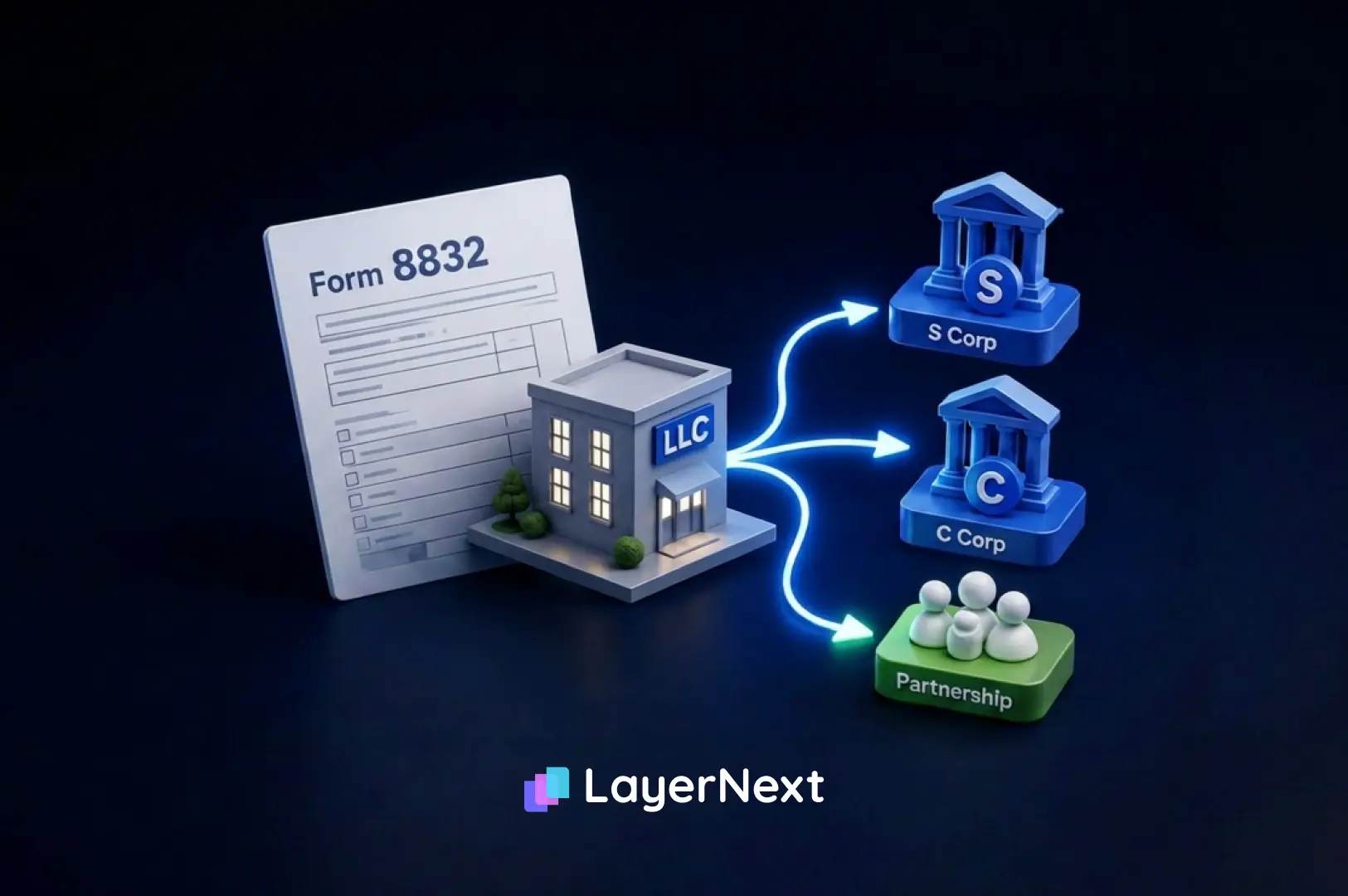
By default, the IRS classifies LLCs based on their ownership structure. Form 8832 gives owners the power to override that default. The available elections are to be taxed as a C-Corporation, a partnership, or a disregarded entity (for single-member LLCs).
It is important to understand what Form 8832 does not do. It does not convert your LLC into a corporation under state law. Your LLC remains an LLC for legal purposes. The election is purely for federal income tax treatment. It also does not make you an S-Corporation. That requires a separate filing: Form 2553. Form 8832 is specifically for C-Corp, partnership, or disregarded entity elections.
Eligible entities include domestic LLCs, certain foreign entities, and any business organization that is not automatically classified as a corporation under IRS rules. Statutory corporations, certain foreign entities with per se corporation status, and entities that have already made elections are generally not eligible.
For official details, refer directly to the IRS Form 8832 page.
Default Tax Classifications Before You File
Before you can appreciate what Form 8832 does, you need to understand what happens if you do nothing.
For a single-member LLC, the IRS treats the business as a disregarded entity by default. That means the LLC does not file its own tax return. Income and expenses flow directly to the owner's personal return through Schedule C. The owner pays income tax and self-employment tax on all net profits.
For a multi-member LLC, the IRS treats the business as a partnership by default. The LLC files Form 1065, and each partner receives a Schedule K-1 showing their share of income, deductions, and credits. Each partner then reports that on their personal return and pays self-employment tax on their share of active income.
Both defaults have their place, especially for smaller or simpler businesses. But as income grows, as investor relationships become relevant, or as reinvestment of profits becomes a priority, these defaults can become expensive. That is the core problem Form 8832 is designed to solve.
When Should You File Form 8832?
This is the most important question for any LLC owner considering this form. Filing Form 8832 makes sense in specific situations. Here are the most common ones.
You want to be taxed as a C-Corporation to retain and reinvest profits. If your business is growing fast and you plan to leave most of the profits in the company rather than distributing them to yourself, C-Corp taxation can be advantageous. The federal corporate tax rate is a flat 21 percent. If your personal income tax rate is higher than that, retaining earnings inside the entity and paying the corporate rate on them instead of passing them through to your personal return can result in meaningful tax savings.
You are seeking venture capital or institutional investment. Many venture capital firms and institutional investors prefer to invest in C-Corporations. Electing C-Corp taxation through Form 8832 (while maintaining your LLC structure) can make your entity more compatible with investor expectations around equity structure, profit distribution, and exit planning.
You operate internationally or have foreign members. Foreign nationals and entities are often subject to different tax treatment. In some cases, C-Corp status through a Form 8832 election can simplify the tax situation for foreign members or create a cleaner structure for international operations. You should always involve a tax professional when cross-border issues are present.
Your self-employment tax burden has become significant. By default, active LLC owners pay self-employment tax of 15.3 percent on net earnings up to a threshold, and 2.9 percent above it. If profits are high and you are looking for ways to reduce that burden, electing C-Corp status is one route. Another is filing Form 2553 to elect S-Corp treatment, which has its own advantages and limitations discussed in the next section.
You are restructuring ownership or converting from another entity type. Major changes in ownership structure, such as adding new members, removing members, or converting from a sole proprietorship, are often good moments to evaluate whether your current tax classification still makes sense.
You need a retroactive election to correct a past filing issue. Form 8832 can be made effective up to 75 days before the filing date, which means it can apply retroactively in certain situations. If you failed to make an election at the right time and your existing classification has caused a problem, late election relief may be available.
When not to file: If your business is small, straightforward, and just starting out, the administrative complexity of C-Corp taxation likely outweighs any benefit. C-Corp elections introduce double taxation on dividends, more rigorous accounting requirements, and additional compliance costs. You should not file Form 8832 without first understanding the full tax picture with the help of a CPA or tax attorney.
Form 8832 vs. Form 2553: Which One Do You Need?
This is one of the most common sources of confusion for LLC owners. Both forms involve changing how your LLC is taxed, but they lead to entirely different outcomes.
Form 8832 is used to elect C-Corporation, partnership, or disregarded entity tax treatment. Form 2553 is used to elect S-Corporation tax treatment. These are not interchangeable.
Can you file both forms? In some cases, yes. An LLC that wants S-Corp treatment must first be classified as a corporation (using Form 8832 if needed) and then make the S-Corp election via Form 2553. However, many LLCs can file Form 2553 directly without filing Form 8832 first. A tax professional can advise on which path applies to your situation.
For a deeper look at S-Corp elections and how they compare to C-Corp treatment for LLC owners, see related resources on the LayerNext blog.
Eligibility Requirements
Not every business can file Form 8832. Before you prepare the form, confirm that your entity meets the eligibility criteria.
Eligible entities include domestic LLCs (single-member and multi-member), foreign entities that are not classified as per se corporations under IRS regulations, and certain other unincorporated organizations.
Entities that are NOT eligible include entities that are automatically classified as corporations under the Internal Revenue Code (such as entities incorporated under state law as corporations), real estate investment trusts (REITs), certain publicly traded entities, and entities that have already made a Form 8832 election within the past 60 months and want to change again.
The 60-month rule is a critical restriction. Once an entity makes an election using Form 8832, it cannot make another election within 60 months (five years) unless the IRS grants an exception. This is an important planning constraint. If you are going to make the election, make sure you are committing to it for at least five years.
All members of the LLC must consent to the election. This is not just a best practice; it is a legal requirement. If even one member has not consented, the election can be challenged. Consent is typically documented in the form itself or through a separate written agreement.
For foreign entities, there is an additional consistency rule: the entity's tax treatment in its home country must be consistent with the elected U.S. treatment in certain respects. This is a nuanced area that requires professional guidance.
Step-by-Step: How to Complete Form 8832
Here is how to complete and file Form 8832 correctly.
Step 1: Determine your current classification. Before you elect a new classification, confirm what your entity is currently treated as for federal tax purposes. If you have never filed Form 8832 before, your classification is whatever the IRS default is for your LLC structure (disregarded entity for single-member, partnership for multi-member).
Step 2: Decide on your new elected classification. Based on your business goals, choose whether you want to be taxed as a C-Corporation, a partnership, or a disregarded entity. For most LLC owners filing Form 8832, the C-Corporation election is the reason they are filing.
Step 3: Obtain consent from all eligible members. Every member of the LLC must consent to the election. Document this consent clearly. The form itself has a signature section for this purpose.
Step 4: Complete Part I - Election Information. This section requires basic information about your entity: name, employer identification number (EIN), address, and the type of election you are making. You will indicate whether this is an initial classification election or a change in classification, and what your current classification is.
Step 5: Complete Part II - Late Election Relief (if applicable). If you are filing the form after the deadline has passed and are seeking relief under Revenue Procedure 2009-41, you will complete Part II and explain the reasonable cause for the late filing.
Step 6: Sign and date. The form must be signed by an authorized person. For an LLC, this is typically a managing member or authorized officer. All members who are required to consent must also sign.
Step 7: File by mail to the correct IRS address. Form 8832 is not filed electronically. It is mailed to the IRS service center for your state. The correct mailing address depends on your location and can be found in the IRS Form 8832 instructions.
Step 8: Keep a copy and watch for confirmation. The IRS will send a copy of the accepted Form 8832 to both the entity and the entity's tax representative. Keep this for your records. You will also need to attach a copy of the accepted form to your federal tax return for the year in which the election is effective.
Deadlines and Effective Dates
The effective date of a Form 8832 election is one of the most important details to get right.
The standard rule is that the election can be effective no earlier than 75 days before the date the form is filed, and no later than 12 months after the date the form is filed. This gives you a meaningful window in both directions.
For example, if you file Form 8832 on June 1, 2025, you can elect an effective date as early as March 18, 2025 (75 days prior), or as late as June 1, 2026 (12 months forward). This flexibility allows you to align the election with the start of a tax year or a significant business event.
If you miss the window entirely, late election relief may be available under Revenue Procedure 2009-41. To qualify, the entity must have failed to make a timely election due to reasonable cause, must have acted as if the intended election were already in effect, and all relevant tax returns must have been filed consistently with the intended election.
It is worth noting that if the effective date falls in a prior tax year, you may need to amend prior tax returns to reflect the new classification. This adds complexity and cost, which is why timely filing is strongly preferred.
Tax Implications of Each Election
Understanding the tax consequences of each election option is essential before you file.
C-Corporation election: Your LLC will be taxed at the 21 percent flat corporate rate on its net income. This sounds appealing, but there is a significant trade-off. When profits are distributed to members as dividends, they are taxed again on the member's personal return. This is the double taxation issue associated with C-Corporations. However, if you do not plan to distribute profits and instead reinvest them into the business, the C-Corp election can be highly efficient. Retained earnings inside the company are taxed only at the 21 percent corporate rate.
Partnership election: Income flows through to members' personal returns in proportion to their ownership share. Members pay income tax and potentially self-employment tax on their allocable share of profits. This avoids double taxation but preserves the self-employment tax burden that many owners are trying to reduce.
Disregarded entity election: Available only for single-member LLCs. All income and expenses are reported on the owner's personal return. Simple and low administrative burden, but the owner pays full self-employment tax on all net income.
To illustrate with a simple example: if your LLC earns $200,000 in net profit and you are in the 32 percent personal income tax bracket, passing that income through as a disregarded entity would result in roughly $64,000 in income tax plus approximately $14,130 in self-employment tax. If instead you elect C-Corp taxation and retain all earnings in the business, the federal tax would be approximately $42,000 (21 percent of $200,000), a savings of over $36,000 in that year. Of course, this comparison becomes more complex when you account for salary requirements, state taxes, and future dividend distributions, which is why professional guidance matters.
Common Mistakes to Avoid
Even with the best intentions, LLC owners make avoidable errors when filing Form 8832. Here are the most common ones.
Filing without documented member consent is one of the most frequent issues. The IRS requires that all eligible members consent to the election. If you file without collecting and documenting that consent, the election can be invalidated.
Missing the effective date window is another common problem. If you want the election to apply to the current tax year, you need to file within the correct window. Many owners wait too long and end up needing to file a late election with relief claims.
Confusing Form 8832 with Form 2553 leads to wasted time and potential compliance issues. If you want S-Corp treatment, Form 8832 is typically not what you need. Confirm which form applies before you file.
Not notifying your state tax authority is a step many owners skip. Federal and state tax classifications are separate. Some states have their own entity classification rules and require notification or a separate election form when your federal classification changes. Not updating your state can create a mismatch in your tax filings.
Forgetting to attach Form 8832 to your federal tax return for the first year the election is effective is a technical but important requirement. The IRS expects to see the accepted form attached to the return for the election year.
Failing to update payroll records, EIN accounts, or banking agreements after a classification change can also cause downstream problems. A C-Corp election changes how payroll taxes are handled and may trigger new filing obligations.
State-Level Considerations
Form 8832 changes your federal tax classification, but it does not automatically change how your state treats your business for tax purposes.
Some states follow federal classification automatically. Others have their own rules or require a separate state-level filing. A few states do not recognize entity classification elections at all and will continue to tax your LLC under state default rules regardless of what you elected federally. California, for example, has specific rules around LLC taxation that operate independently of the federal election.
This mismatch can create situations where you are a C-Corporation for federal purposes but still treated as a partnership or disregarded entity by your state. You could end up with different tax returns for federal and state purposes, which requires careful coordination.
Before you file Form 8832, check the specific rules for every state in which your LLC does business. If you operate across multiple states, this analysis becomes even more important. A CPA with multi-state experience can help you navigate this correctly.
When to Involve a Tax Professional
Form 8832 itself is not a long or complicated form. But the decision behind it is. The tax implications of changing your entity classification can affect your business for years, and the 60-month rule means you cannot easily undo the election if your situation changes.
You should strongly consider involving a CPA or tax attorney if your LLC earns more than $100,000 in annual net profit, if you have multiple members or complex ownership arrangements, if you have or are seeking outside investors, if your LLC operates in multiple states or internationally, or if you are considering the C-Corp election specifically for investor or exit planning reasons.
The cost of a consultation is small compared to the potential cost of making the wrong election or filing incorrectly. Ask your tax advisor to model out the scenarios: current default treatment versus your elected option, over a 3-to-5-year horizon, including state taxes and any anticipated distributions.
Questions worth asking your advisor include: What would my total tax liability look like under each classification over the next three years? Does electing C-Corp status affect my eligibility for any deductions I currently take? How will this election interact with my state taxes? Is there a better time of year to make this election effective?
LayerNext: Helping Business Owners Make Smarter Decisions
At LayerNext, the mission is to give business owners the tools and intelligence to operate with greater precision. Whether that means understanding the financial implications of a tax election, tracking business performance across dimensions, or making data-driven decisions about growth, LayerNext is built for the modern operator who wants clarity without noise.
Decisions like the one covered in this guide whether to file Form 8832 and elect a new tax classification are exactly the kind of consequential, multi-variable choices where having the right information framework makes all the difference. LayerNext helps you build that framework across your business, so that decisions like this happen inside a broader picture of financial health and strategic direction, not in isolation.
If you found this guide useful, explore the rest of the LayerNext blog for practical resources on business formation, tax strategy, financial planning, and growth operations. Every article is written to give you the clearest possible path from question to confident decision.
Frequently Asked Questions
Conclusion
Form 8832 is one of the most powerful and least utilized tools in the LLC owner's tax toolkit. The ability to change how your business is classified for federal tax purposes gives you flexibility that most business owners never take advantage of, often because they simply do not know it exists.
The key takeaways from this guide are straightforward. You have a default tax classification whether you like it or not. That default may or may not be optimal for your situation. Form 8832 lets you change it, but only under certain conditions and within specific timeframes. The C-Corp election is the most commonly sought outcome, and it works best for businesses that retain profits rather than distribute them. The 60-month rule means you should commit carefully before you file.
The best next step is to bring this conversation to a qualified tax professional and model out the numbers for your specific situation. Use this guide as your starting point, not your final word.
Explore more practical resources for LLC owners and growing businesses at LayerNext.ai.