Summary
RPA (robotic process automation) automates finance tasks by following a fixed script. It clicks the same buttons, in the same order, every time, and breaks the moment an invoice format or screen layout changes. AI agents in finance read messy, unstructured data, handle exceptions, and complete a task the way a person would, adjusting when something doesn't match the usual pattern. Most finance teams don't need to pick one forever. They need to know which tasks belong to which technology, and increasingly, teams are shifting AP, reconciliation, and reporting work from RPA to AI agents because RPA can't keep up with real-world data.
If you've searched "RPA vs AI," "AI vs RPA," or "is RPA and AI the same thing," you've probably found a wall of vendor pages that all say the same thing without explaining why it matters for your books. This guide breaks down what each technology actually does in a finance context (accounts payable, bank reconciliation, financial reporting) and how to decide where to spend your automation budget in 2026.
What Is RPA?
Robotic process automation (RPA) is software that mimics the exact mouse clicks, keystrokes, and copy-paste actions a human would perform inside an application. An RPA "bot" is built by recording or scripting a specific sequence of steps: log into the ERP, open a screen, enter a value in field A, click submit. It then replays that sequence on a schedule or trigger.
RPA doesn't understand what it's doing. It has no concept of what an invoice is or why a number should go in a particular field. It just executes the recorded path. That's exactly why RPA became so popular for finance back-office work in the first place: rule-based, repetitive, high-volume tasks with almost no variation are precisely what a scripted bot is good at. It's also why RPA is brittle. Change the layout of a screen, receive an invoice in a format the bot hasn't seen, or hit a field that's blank instead of populated, and the bot stops or does the wrong thing.
What Are AI Agents in Finance?
AI agents in finance are systems built on large language models that can interpret a goal, work through the steps needed to reach it, take action inside real software, check their own results, and ask a human when something is genuinely unclear. Instead of following a fixed script, an AI agent is given an outcome, something like "process this invoice and get it ready to post," and works out the steps itself, adjusting when the invoice looks nothing like the last one.
This is the technology behind what the industry calls agentic AI finance tools: software that plans out multi-step financial work, carries it out, and checks its own results rather than waiting for a human to trigger each individual action. In accounts payable, an AI agent doesn't just extract fields from a PDF. It understands that the invoice relates to a purchase order, checks whether the goods were received, applies your specific approval and GL-coding rules, and only brings in a person when there's a genuine exception, like a price mismatch, a duplicate, or a new vendor. That's a real step up from a bot replaying a click sequence.
RPA vs AI Agents: The Core Differences
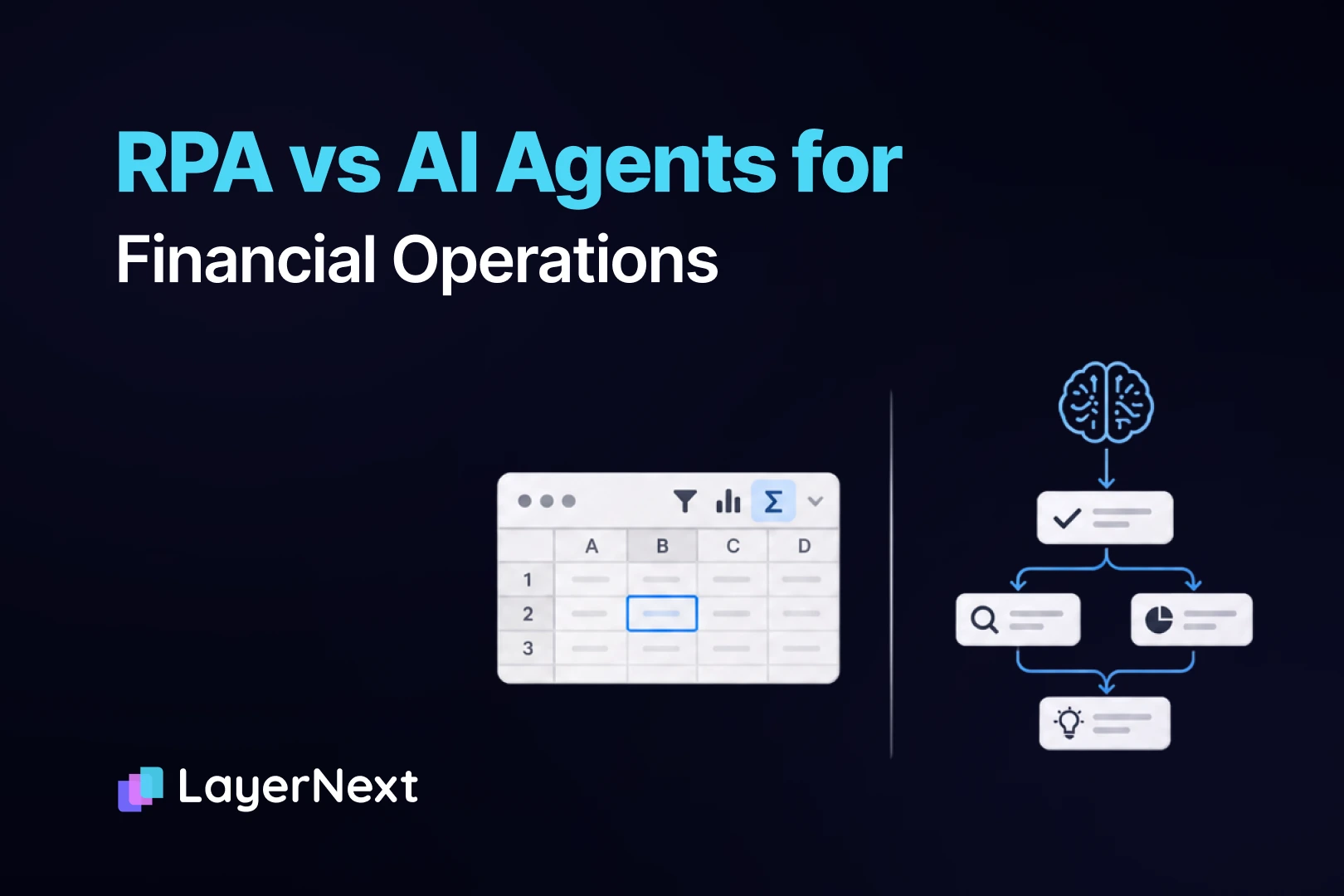
Bottom line: RPA is a script that repeats. An AI agent is a system that works through a problem, adapts, and finishes the job even when the input isn't perfectly clean.
RPA vs AI Agents in Accounting: Where Each One Actually Shows Up
The theory is easier to see against real finance workflows. Here's how RPA and AI agents in accounting compare on the tasks that actually eat a finance team's week.
RPA Accounts Payable
RPA accounts payable workflows typically automate a narrow slice of the process: moving already-extracted invoice data from one system into another, or clicking through the same ERP screens to enter a bill that matches a known template. RPA accounts payable bots handle the automation of accounts payable process steps well when every invoice looks identical: same vendor, same layout, same fields, every time.
The problem is that real AP doesn't work that way. Vendors change invoice templates. PDFs arrive as scanned images. A field is blank one month and populated the next. Each of those variations either breaks the bot or routes the invoice to a human anyway, which is why so many "automated" AP departments still have someone keying a large share of invoices by hand.
AI Agents in Accounts Payable
An AI agent handles accounts payables automation differently: it captures the invoice regardless of format, extracts and validates the data, matches it to the purchase order and receipt, applies your approval chain and GL-coding rules, and routes only genuine exceptions, such as a missing PO, a price variance, or a new supplier, to a person for review. It doesn't require a template for every vendor, and it doesn't stop working when a supplier redesigns their invoice.
Bank Reconciliation
RPA can move transaction data between a bank feed and a ledger on a schedule, but matching is typically limited to exact-match rules. AI agents can match transactions the way an experienced accountant would, accounting for timing differences, partial payments, and transactions that don't line up one-to-one, and surface only the discrepancies that actually need a human decision.
Financial Reporting and Close
RPA can populate a template with numbers pulled from a known source on a known schedule. It can't tell you why burn rate moved, flag an anomaly it hasn't seen before, or answer a plain-language question about cash flow. AI agents can generate the report and the commentary, because they're working through the underlying data rather than just relocating it.
Is RPA and AI the Same Thing?
No. RPA and AI are not the same thing, even though they're both automation technologies and both get used to reduce manual finance work. RPA is a scripted tool. It does exactly what it was programmed to do and nothing more. AI, and specifically the AI agents built on today's language models, can interpret unfamiliar data, make judgment calls within rules you set, and complete a task even when the exact scenario wasn't explicitly programmed in advance. Some modern platforms combine both, using RPA-style actions for simple, stable data movement and AI for the parts that require judgment, but "RPA" and "AI" describe two different underlying technologies, not two names for the same thing.
AI Agents vs. Automation: Aren't AI Agents Just Automation Too?
Yes and no. AI agents are a form of automation (the goal is still to reduce manual work), but "automation" is a broad category that includes everything from a simple Excel macro to a scripted RPA bot to an AI agent. What separates AI agents vs. automation in the traditional sense is autonomy: older automation executes a fixed set of instructions, while an AI agent can decide how to get from A to B, adjust its approach mid-task, and recognize when it needs a human. If a tool breaks the moment something unexpected happens, it's automation in the older sense. If it adapts and keeps going, that's what people mean by agentic.
RPA or AI: Which Is Better for Finance Teams?
Neither technology is universally "better." They're built for different kinds of work, and the right answer depends on the task in front of you.
RPA still makes sense when:
- The process is 100% stable and has been unchanged for years
- Every input follows an identical, predictable format
- There are effectively zero exceptions to handle
- The workflow is simple enough that reprogramming it occasionally is cheap
AI agents make more sense when:
- Invoice formats, vendors, or document types vary
- The task involves any judgment call, matching, or exception handling
- You're working with legacy or desktop ERPs that don't expose a clean API
- The team is spending more time maintaining bots than the bots are saving in labor
For most finance departments processing real-world accounts payable, reconciliation, and reporting volume, the honest answer to "RPA or AI, which is better" is that AI agents now cover nearly everything RPA used to handle, plus the exception-heavy work RPA was never able to touch. That's less a hybrid recommendation and more a description of where the market has already moved: the finance automation stacks built in the RPA era are steadily being replaced, not supplemented, by agentic systems that don't need a separate escalation path for every edge case.
Why Finance Teams Are Moving Beyond RPA
Finance automation has gone through a few distinct phases. Optical character recognition (OCR) tools first digitized invoice data but broke on anything unfamiliar. RPA layered scripted clicks on top, which worked as long as nothing changed. AI and machine learning added the ability to handle messier data and learn from corrections. The current phase, computer-use AI agents, takes that further and applies it directly inside the applications finance teams already use, including legacy and desktop ERPs that were never built with an API and were previously the hardest systems to automate at all.
Gartner, which tracks enterprise adoption of this shift, predicts that 33% of enterprise software applications will include agentic AI by 2028, up from under 1% in 2024, and separately, that at least 15% of day-to-day work decisions will be made autonomously through agentic AI by the same year. Gartner has also flagged a real risk worth knowing about if you're evaluating vendors: "agent washing," where products built on old RPA or chatbot technology get rebranded with agentic AI marketing language without the underlying capability to back it up. The distinction in this article, script versus judgment, is exactly the test worth applying when a vendor claims to be "agentic."
The practical driver behind the shift, though, is simpler than any market forecast: RPA bots require ongoing maintenance every time a screen, format, or system changes, and finance data changes constantly: new vendors, new invoice layouts, new ERP versions. AI agents remove that maintenance cycle because they adapt instead of breaking.
Where LayerNext Fits
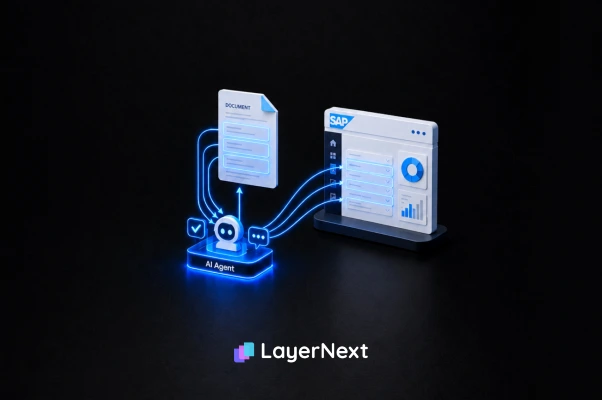
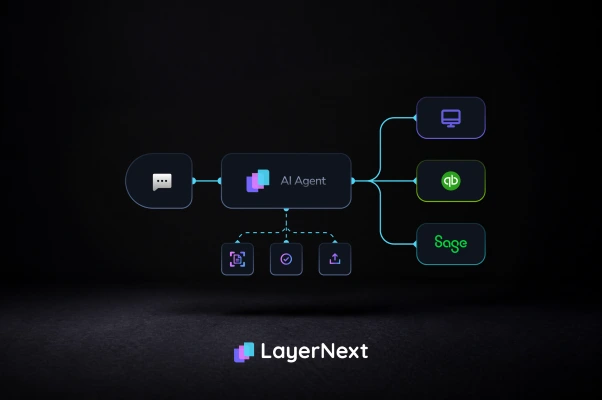
LayerNext builds AI agents for finance operations. It isn't RPA, and it isn't RPA with an AI feature bolted on. The agents process invoices, reconcile bank accounts, and generate CFO-grade reports across QuickBooks, NetSuite, Sage, Microsoft Dynamics, SAP, and legacy or custom ERPs, including systems with no API at all. Because the agents interact with your software the same way a person would, they work in environments where traditional RPA and even most modern AP tools can't connect.
In practice, that means:
- AP automation that captures, validates, matches, and routes every invoice for approval, without needing a template for every vendor
- Real-time bank reconciliation that matches transactions the way an expert accountant would, not just on exact-match rules
- Support for legacy and desktop ERPs with no API access, using the same approach that finally closes the gap RPA left open
- Built-in review steps, including approvals, validation gates, and a full audit trail, so AI moves fast without finance losing control of what actually posts to the books
Finance teams using LayerNext report saving 90 to 165 hours per month on manual finance work, with a 90 to 100% reduction in processing errors and 95%+ task accuracy on defined workflows, deployed in weeks rather than months. If your team is still maintaining RPA scripts or manually re-keying the invoices your current tool can't read, see how LayerNext's AI agents handle AP, reconciliation, and reporting, including on the legacy ERPs most automation vendors avoid.
Frequently Asked Questions