Summary
- Multi-branch or multi-ERP supplier: LayerNext, Esker or Rillion. They post into more than one system. They differ in how: LayerNext uses the ERP's API or its own screens, Esker usually works through a partner, and Rillion through a custom integration.
- One location on one ERP: use that ERP's own AP module if it has one. Epicor BisTrack AP Assist reads invoices with no template per vendor. Eagle's needs a template for each vendor.
- Approvals are the main problem and the ERP posting is fine: Stampli.
- Vergo and Field Materials code invoices to jobs and cost codes. They suit a contractor, or a contracting division inside a dealer, and do not suit a supplier's freight, credit and rebate work.
- Ask each vendor how the invoice gets into your ERP before you ask anything else.
The right AP automation software for building materials depends on how many ERPs you run and who does the posting. One location on Epicor BisTrack can start with Epicor's own AP Assist. A multi-branch dealer group, or a business that kept the ERPs of the companies it bought, needs software that posts into each system and handles freight, credits and rebates.
Supplier invoices are harder than they look. The mill adds freight that was never on the PO. A truck arrives short. The price moves between order and ship date. A credit memo for damaged sheets lands two weeks after the invoice is paid, and the year's volume rebate depends on whether anyone added up purchases across branches.
LayerNext publishes this article and is on the list. We rank it first for one case, the multi-branch or multi-ERP supplier, and say where it stops. Put the questions below to every vendor, us included.
Tool Comparison Summary
The order assumes a multi-branch supplier. A single location on an Epicor ERP should move Epicor's native module to the top.
The Ranking Weighs Six Things a Supplier's Invoices Test
These six are where supplier invoices separate one tool from another, and the order below follows how each tool handles them.
- How the invoice gets into the ERP: an API, a file import, or the ERP's own screens. A file sync that passes only coding and payment status leaves the posting work in the ERP.
- Matching against the PO and the receipt, with tolerances set by supplier or product type.
- Freight and surcharges that were not on the PO, with a written rule for what is allowed and which account takes it.
- Credit memos and vendor statements, including credits that arrive after the invoice is paid.
- Approvals and exceptions routed by branch, with an owner for each one.
- Volume rebates. In Enable's 2024 State of Volume Rebates Report for Distributors (December 2023, 13 industries including building materials), 52% of distributors believed they did not receive all the rebates they earned.
Run one purchase order through every tool. A dealer orders 1,200 sheets of OSB on PO 4471 at $11.50, or $13,800. The mill ships two loads and bills each with $450 of freight. Invoice A covers 800 sheets at $11.50 and comes to $9,650. Invoice B covers 380 sheets at $11.90 and comes to $4,972, a price 3.5% over the PO. The dock accepts 368 of those 380, because 12 arrived damaged. A credit memo for $142.80 arrives two weeks later.
Paid as billed, the dealer sends $14,622. With the freight allowed, the price accepted and the credit applied, it owes $14,479.20. A good tool catches the freight, the price, the 12 sheets and the late credit without someone reading every line. Anything less leaves AP reading every line.
1. LayerNext
.webp)
LayerNext is an AI-powered financial operations platform. Its AI agents run AP from invoice intake through ERP posting and reconciliation, and the finance team writes the rules in plain English. On OSB order 4471, an illustrative rule might read: pass when the billed quantity equals the accepted quantity and the price is within 2% of the PO, allow freight up to $500 a load from this mill, and hold the rest for the branch. Invoice A passes and posts without anyone touching it. Invoice B stops for two reasons, the 12 damaged sheets and the 3.5% price increase, and each goes to the person who owns the answer. A person is involved for exceptions, errors and rule-assigned approvals, and every AI action and human decision is logged. It is a separate platform, so it adds a vendor and a rollout of 7 to 12 weeks, and one location whose ERP module already does the job does not need it. See AP automation for building material suppliers.
Features:
- Invoice intake by dedicated email address, shared folder, cloud storage or phone photo, read without templates
- PO and receipt matching with tolerances written in plain English
- Freight, surcharge and credit memo rules
- Vendor statement reconciliation and volume rebate tracking
- Posting through the ERP's API or its own screens, on Eagle, BisTrack, LumberTrack, ECI Spruce, DMSi Agility and other ERPs
Pricing: Volume-based and quoted per account on the Enterprise plan, which covers AP on any ERP.
Complexity: Medium; phased over 7 to 12 weeks (discovery in weeks 1 to 2, pilot in weeks 3 to 6, full deployment in weeks 7 to 12).
Trial: Demo-based;
2. Epicor Native AP Modules (BisTrack, Eagle and LumberTrack)
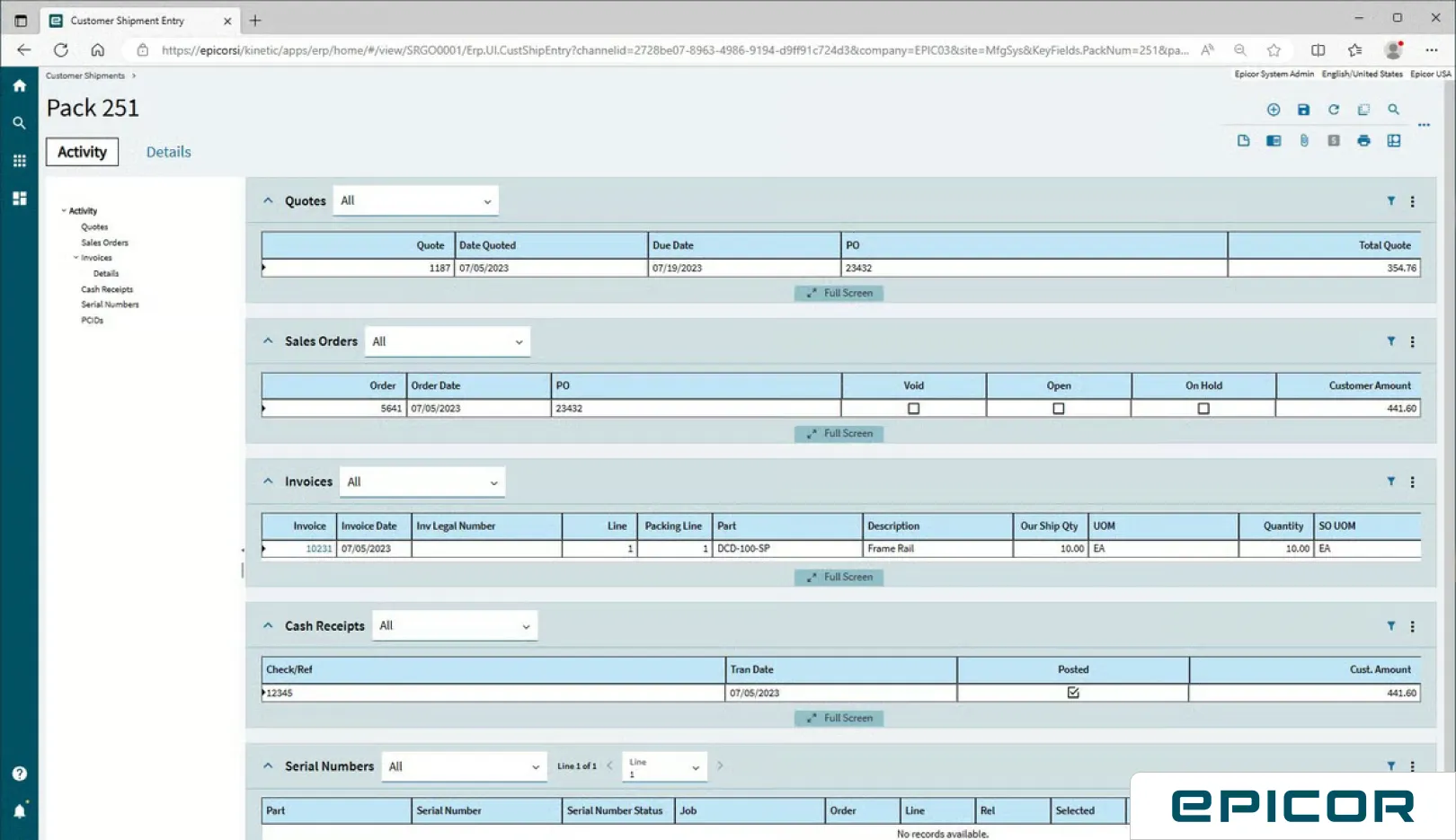
Epicor ships an AP module inside each of its LBM ERPs, and for one location on one of them it is the first thing to price, because it sits in the ERP the team already uses and nothing new has to connect. BisTrack AP Assist reads emailed and scanned invoices with AI-based OCR, needs no template for each vendor, matches two-way or three-way and creates the payable in BisTrack. Eagle's AP Assist reads scanned invoices through a Webdocs template, and Epicor's setup steps create one template per vendor, which suits a stable vendor list and becomes a queue for a business that adds vendors through acquisitions. LumberTrack introduced AP Automation with the LumberTrack 2020 release in November 2019, using OCR on scanned vendor invoices that feeds Vendor Invoicing. Each module covers its own ERP only, so ask how it treats a freight line that was not on the PO, how it applies a credit memo that arrives after the invoice, and whether it reconciles vendor statements or tracks rebates.
Features:
- BisTrack: AI-based OCR with no template for each vendor, two-way and three-way matching, payables created inside BisTrack
- Eagle: invoices posted against the receiving document in the AP Assist Processing Viewer, with a Webdocs template for each vendor
- Eagle import needs a vendor code, PO number, invoice number and invoice total, and non-PO bills such as utilities go through as expense invoices
- LumberTrack: OCR on scanned vendor invoices that feeds Vendor Invoicing
- Exception-based review
Pricing: Not publicly listed; contact Epicor for the module that matches your ERP.
Complexity: Low to medium on BisTrack and LumberTrack, which are native with no separate integration. Medium on Eagle, because each vendor needs a template before its invoices are read.
Trial: Contact Epicor; no published free trial.
Mike Janik, CPA, CGA
CFO, Sexton Family of Companies

3. Esker
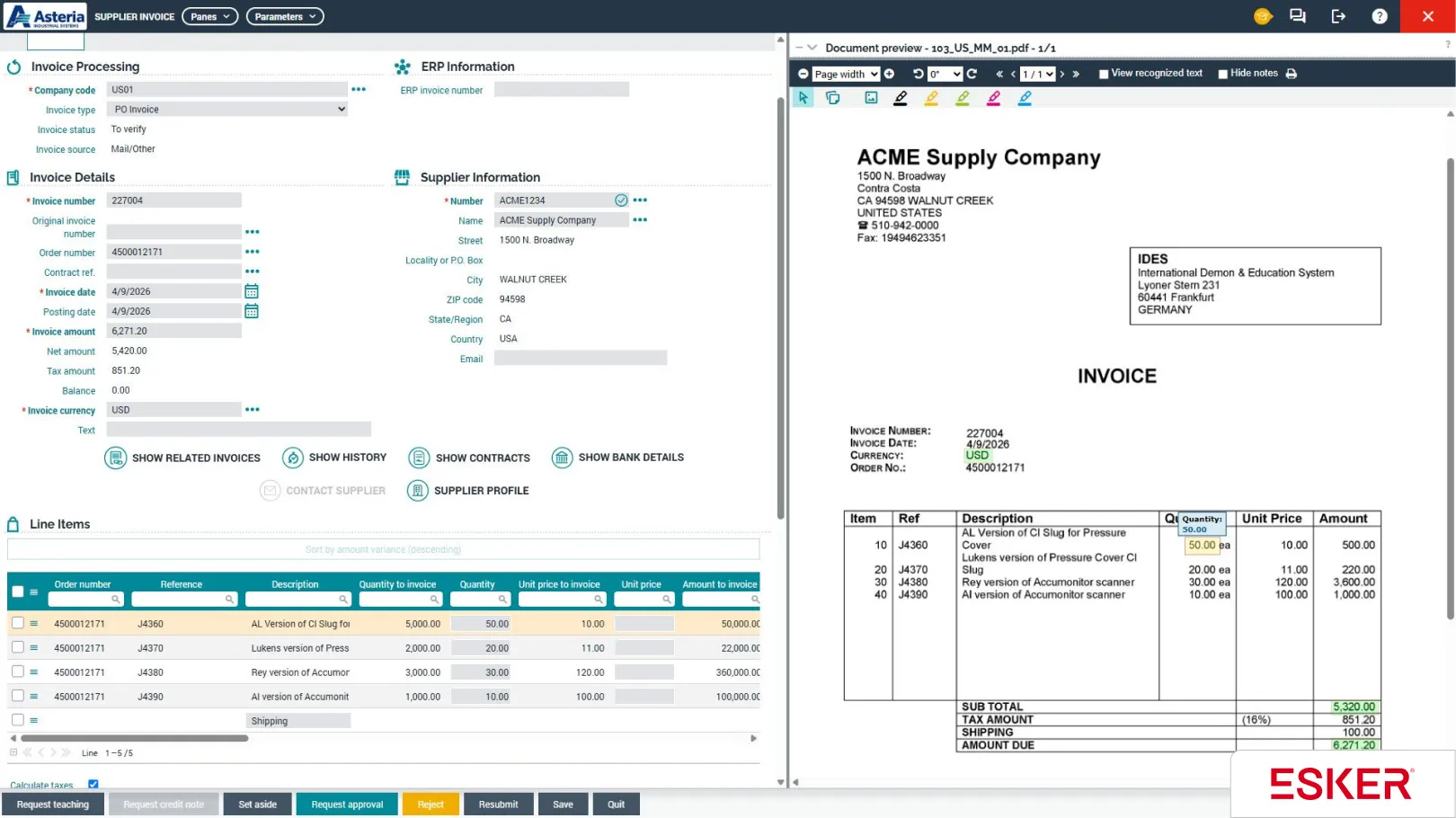
Esker is a source-to-pay suite aimed at large companies and complex finance organizations. It also covers order and receivables automation, which matters to a distributor with sales and purchasing volume to automate together. For LBM ERPs it usually arrives through a partner, such as Enlighten.Net for DMSi Agility, so scope and connector depend on the partner and your ERP. Confirm the posting method for your system before anything else.
Features:
- AI invoice capture, automated coding and validation
- Approval routing and exception management
- AP, AR and order automation in one suite
- ERP connectors delivered through partners
Pricing: Not publicly listed.
Complexity: Medium to high; scope depends on the partner and your ERP.
Trial: Demo-based; no published free trial.
4. Rillion
.webp)
Rillion is an AP platform with three-way PO matching, approval workflows and multi-entity management. Robinson Lumber runs LumberTrack for PO invoices and Microsoft Dynamics GP for non-PO invoices. Vendors email invoices to one inbox, ReadSoft captures them, Rillion matches them to POs and the results post back to both ERPs. The company reports more than 700 hours saved a year. The integration was a custom project, built jointly with the LumberTrack team, so a different pair of systems means a new scope and a new timeline.
Features:
- Three-way PO matching
- Approval workflows
- Multi-entity management
- Custom integration for a two-ERP setup, as at Robinson Lumber
Pricing: Not publicly listed. Essential, Professional and Premium plans are priced to your needs and invoice volume.
Complexity: Medium to high; a custom integration project for each pair of ERPs.
Trial: Demo-based; no published free trial.
5. Stampli
.webp)
Stampli is an invoice collaboration and approval tool. Questions about an invoice are asked and answered on the invoice itself, and duplicates are flagged, which addresses invoices that sit with the wrong approver for days. Its ECI integration is a file integration that syncs invoice coding and payment data. What lands in the ERP depends on what the file sync covers, so confirm your ECI product is supported and ask who keys the bill.
Features:
- Invoice collaboration on the invoice itself
- Duplicate invoice flagging
- Approval routing
- File integration that syncs coding and payment data with ECI products
Pricing: Quote-based.
Complexity: Low to medium; a file integration, with no change to how the ERP is used.
Trial: Demo-based; request a quote.
6. Vergo
Vergo connects through the BisTrack REST API, which your team turns on once. It reads branches, jobs, cost codes, GL accounts and suppliers from BisTrack and posts coded supplier invoices and card spend back, with BisTrack staying the system of record. It is built around job cost, so a dealer with an installed-sales or contracting division may use it for that division. It is not built around freight rules, vendor statements or rebates, and bank reconciliation is worth asking about.
Features:
- Connects through the BisTrack REST API
- Reads jobs, cost codes, GL accounts and suppliers from BisTrack
- AI invoice processing with GL and job code auto-coding
- Expense management and card spend on the same platform
Pricing: AP Automation is $0.50 per invoice processed plus a platform fee. Expense Management starts at $5 per user per month.
Complexity: Low to medium; your team turns on the BisTrack API once.
Trial: Demo-based; no published free trial.
7. Field Materials
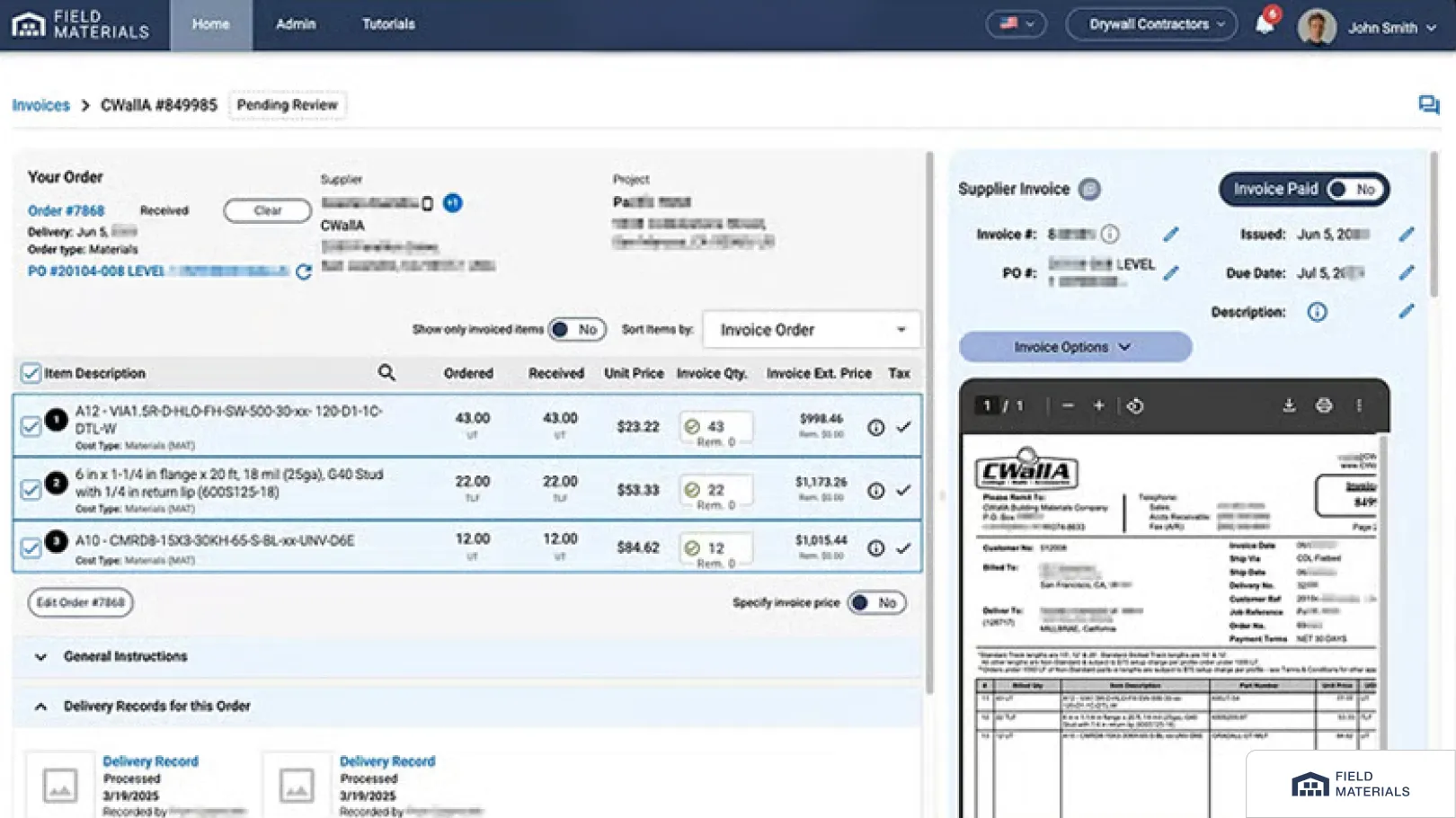
Field Materials handles procurement and AP for contractors. It tracks ordered, received and invoiced quantities per material and cost code, validates three ways, and syncs with construction accounting systems such as Viewpoint Vista. It works from the buyer's side of the invoice, and a supplier is on the other side of it.
Features:
- Ordered, received and invoiced quantities per material and cost code
- Three-way validation
- AI agents for procurement, AP automation and inventory management
- Syncs with construction accounting systems such as Viewpoint Vista
Pricing: Not publicly listed.
Complexity: Medium; syncs with the contractor's construction accounting system.
Trial: Demo-based; no published free trial.
A Native Module Is Enough for One Location on One ERP
Skip a separate platform in these cases.
- One location, one ERP, a steady vendor list and few credits. The module you already license covers capture and matching.
- A team whose only problem is slow approvals. Stampli may be all it needs.
- A group in the middle of an ERP replacement. Wait until after go-live, because the posting step will change.
- A dock that does not enter receipts. Three-way matching cannot match a receipt nobody entered, so fix receiving first.
Exceptions will not go away under any tool. In Ardent Partners' AP Metrics That Matter in 2026, 19.9% of invoices need manual exception handling before they can be paid. Judge a tool by how each exception arrives, with the invoice, the supplier and the reason attached, and not by a touchless rate.
Start With One Branch and Its Worst Invoices
Pick the branch with the most open orders and a manager ready to own the rules. Before any software, pull last month's AP and count three things.
- Invoices where the billed quantity differed from the accepted quantity.
- Freight and surcharge lines that were not on the PO, with their total.
- Credit memos older than 60 days that are still unapplied on vendor statements, with their total.
Measure the same three after a pilot to see whether the hours came back. Then send each vendor the invoices behind the first two and ask what posts, what goes to a person, and why.
FAQ