


Summary
Epicor Kinetic and Epicor Vantage are two different generations of the same manufacturing ERP. AP automation works differently on each one. This page covers what a controller or AP manager can expect from each platform, why three-way matching gets harder past a single plant, and what changes if your company is mid-migration between the two.
Both systems fall under the broader category of epicor manufacturing software. Both are still running live AP workloads at real manufacturers today. Kinetic is Epicor's current cloud ERP. Vantage is the platform it replaced, and Epicor has been telling Vantage customers to move off it for years.
- Epicor Kinetic and Epicor Vantage handle AP differently. Kinetic has a native financials module plus an optional ECM add-on for invoice capture and matching. Vantage predates most of that and typically runs AP through manual entry or file-based workarounds.
- Third-party research rates Kinetic's financials module "moderate," specifically weaker than SAP's or Oracle's (ERP Research, 2026). That's one reason manufacturers on Kinetic still look outside the ERP for AP automation.
- Three-way matching, checking the invoice against the purchase order and the goods receipt, is the standard for physical goods in manufacturing. Most exceptions trace back to four causes: partial delivery, price variance, a missing receipt, or a unit-of-measure mismatch.
- Best-in-Class AP teams process invoices in 3.1 days with a 9% exception rate, against 17.4 days and 22% for the average team (Ardent Partners, 2025 State of ePayables).
- LayerNext automates AP on both Kinetic and Vantage, carrying the invoice from ingestion through ERP posting and reconciliation rather than stopping at data capture.
AP automation on Epicor Kinetic
Kinetic is Epicor's current ERP, the direct successor to Epicor ERP 10, and it's the platform Epicor is actively selling and developing. Out of the box, Kinetic's financials module handles three core AP functions:
- Vendor invoice entry
- Payment scheduling
- Basic two-way matching against purchase orders
For deeper automation, Epicor also sells an ECM add-on, marketed under the DocStar name. It captures invoice data and performs two- and three-way matching through its own API connection into the accounting system. That's a real capability, but it doesn't close the gap for multi-entity manufacturers. In practice, multi-company offsetting entries in Kinetic AP don't post automatically. Even after an invoice is matched and approved, someone still has to post those entries by hand.
Third-party research rates Kinetic's financials "moderate," specifically weaker than SAP's or Oracle's (ERP Research, 2026), and that assessment holds up among manufacturers actually running it. They describe Kinetic as lacking the depth of resources a larger platform like SAP or Oracle can bring to a support issue. In practice, matching that works cleanly for one plant with a clean item master starts to break once a company runs multiple plants or multiple legal entities on the same Kinetic instance.
That's usually where the real gap sits for Kinetic manufacturers. A plant in one location might code a receipt against a different item number than a sister plant uses for the same part. A corporate entity might need GL coding the AP module was never configured to apply automatically. None of that is a defect in Kinetic exactly. It's what happens when three-way matching has to hold up at multi-plant, multi-entity scale, and that's the same problem no matter which ERP sits underneath it.
AP automation on Epicor Vantage
Vantage is the platform Kinetic replaced. Vantage 8.03 was its last major release before Epicor moved the product line onto Epicor 10 and later Kinetic. Epicor turned off telephone support for Vantage and other pre-9.05 versions on June 30, 2018, according to Epicor implementation partner Teccweb, and it hasn't come back since.
AP automation on Vantage runs into a more basic problem than Kinetic's multi-plant matching issue: there typically isn't a usable API to connect to. Modern AP tools assume an API-accessible ERP, and Vantage doesn't have anywhere for them to plug in. That's pushed most Vantage shops into one of two positions:
- Keep keying invoices by hand
- Export data to a file, then still finish the entry manually
The second option is the same manual step wearing a different disguise.
The practical fix on a system like Vantage is automation that operates through the interface itself, the same screens and fields a person would use, rather than automation that depends on an API the ERP was never built to expose. It's a different mechanism than what runs on Kinetic, but it produces the same outcome: an invoice that gets matched, coded, and posted without someone retyping it.
Automotive and electronics manufacturers on Epicor
Automotive and electronics manufacturers on Kinetic or Vantage often carry hundreds of active suppliers. Engineering change orders hit the item master weekly, not quarterly. A supplier can ship against a superseded part revision while the PO was still cut against the old one. The receipt and the invoice both look correct on their own, and they still fail to match. That's a revision problem, not a price or quantity problem, and it shows up disproportionately on these accounts.
Industrial machinery and fabricated metals manufacturers on Epicor
Industrial machinery and fabricated metals manufacturers on Epicor typically run make-to-order work, where a single purchase order can span months. A large piece of equipment arrives in stages: a supplier might ship and invoice a subassembly this month and the balance next quarter, all against one PO. Matching has to track what's been received cumulatively against that PO, not treat each invoice as its own transaction. That's where a lot of template-based matching logic falls apart on this segment specifically.
Epicor Kinetic vs. Vantage: does AP automation work differently?
Yes, and the difference goes well beyond the API.
Kinetic and Vantage are sold under two different pricing models. Kinetic runs as a subscription: roughly $100 to $200 per user per month plus a base platform fee, with cloud deployments often landing between $4,000 and $20,000 a month all-in for a mid-market manufacturer (ERP Research, 2026). Vantage was sold under a perpetual license: historically $2,500 to $10,000 per user up front, plus 18% to 22% of that every year in maintenance (ITQlick, 2026). A manufacturer weighing whether to automate now or wait for a Kinetic migration is weighing two different cost structures, not just two different systems.
The bigger surprise is invoice approval. Kinetic doesn't ship with native approval routing for AP invoices, and Epicor's own user community has asked for it repeatedly on the official support forum. The workarounds already in use include:
- A custom field marking an invoice approved
- A custom web application built on Epicor's REST API
- A third-party or ECM add-on bought specifically to close the gap
Vantage never had built-in digital routing either. On both platforms, approval is something a manufacturer has to bring in from outside the ERP. Neither one solves it out of the box.
Ardent Partners' 2025 invoice cycle-time figures
That gap shows up at close, not just in the AP queue. Ardent Partners puts the average team's invoice exception rate at 22%, against 9% for its Best-in-Class cohort (Ardent Partners, 2025 State of ePayables). Every flagged invoice in that 22% is one more item a controller has to track down before the books close. Cutting the exception rate is a matching-accuracy problem, not a payment-speed problem, which is why it matters more which platform's matching logic actually holds up than how fast either one can cut a check.
Before automating AP on either platform, it's worth asking any vendor, LayerNext included:
- What happens at the moment of ERP entry: an API, a file export, or direct interface operation?
- Does the matching logic handle multi-plant item masters, or only a single-plant setup?
- Will they run your actual invoices, the ones with a partial shipment or a supplier who changed their layout last month, not a curated demo set?
For a manufacturer mid-migration from Vantage to Kinetic, the practical question isn't which platform to automate first. It's whether the automation you pick can run on both without waiting for the migration to finish.
How LayerNext helps
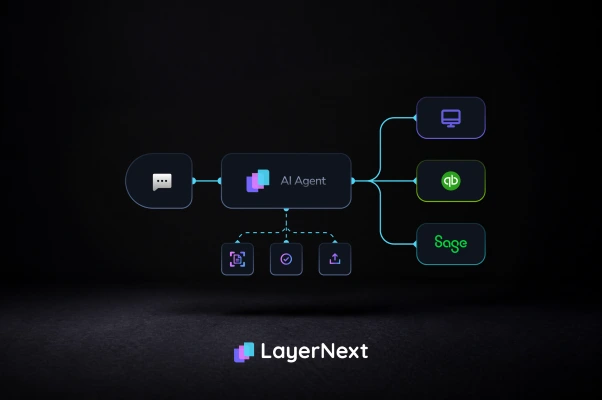
LayerNext runs AP automation on Epicor Kinetic and Epicor Vantage as one process, not two separate projects. Epicor is one system among many it works across: the same platform runs on QuickBooks, Microsoft Dynamics 365, Sage, NetSuite, SAP, and other legacy or custom ERPs, so a manufacturer running Epicor at some plants and a different system at others isn't stitching together separate AP tools to cover each one.
Invoices don't have to change how they already arrive to get automated. LayerNext pulls from whatever channel a plant already uses: a shared inbox, a network folder, a direct feed from Kinetic or Vantage, or files dropped into cloud storage. A manufacturer with one plant emailing invoices and another scanning them into a shared drive doesn't have to standardize intake first.
.webp)
The core of it is three-way matching against the purchase order and the goods receipt, at multi-plant and multi-entity scale, exactly where Kinetic's native matching and most bolt-on AP tools start to lose accuracy. The agents check every invoice against four common exception types:
- Partial delivery: a supplier ships and bills for less than the PO quantity
- Price variance: a surcharge or price change shows up between the PO and the invoice
- Missing receipt: goods arrived but nobody logged it in Epicor
- Unit-of-measure mismatch: a supplier's part codes don't match the item master
Each exception is tagged by invoice number, supplier, and issue type, then routed to the person who can resolve it, instead of sitting in a queue with no context attached.
.webp)
The approval gap covered earlier, that neither Kinetic nor Vantage ships with native invoice routing, is where LayerNext's business rules layer does real work. A controller can write an approval chain or an entity-specific coding rule in plain English: route invoices above a set dollar threshold to a plant controller, code a supplier's freight surcharges to a specific GL account, and so on. Those rules are managed by the finance team directly, with no IT ticket required, and the system can search thousands of them to find the right one for a given supplier or entity in real time.
.webp)
Whether the entry point is Kinetic's current system or Vantage's older interface, LayerNext's agents can complete the ERP posting themselves, reading the same screens and fields a person would use where a reliable integration doesn't exist. That's different from tools that stop once an invoice is captured and matched. Epicor's own ECM module, and most AP platforms built for cloud-only ERPs, still leave someone to push the final entry through and reconcile it later.
Reconciliation isn't a separate project either. Once an invoice posts, LayerNext's agents match the resulting payment against the bank feed as it lands, across every account and entity, instead of leaving it for someone to chase down during close. Human approval happens before anything reaches the ledger, and a full audit trail sits behind every step. That matters to an IT director weighing system risk, and just as much to the controller signing off on close.
For a manufacturer running Kinetic at one plant and Vantage at another, or multiple entities on either one, the same platform also rolls AP and reconciliation activity into consolidated reporting: cash flow, margin, and anomaly alerts across entities, current to today rather than to last month's close. That's usually the next conversation once AP and reconciliation are running cleanly, not a reason to wait to start on AP.
Manufacturers running this see:
- 90 to 165 hours returned to the finance team each month
- 95%+ task accuracy on defined workflows
- Deployment measured in weeks, not months
Mike Janik, CPA, CGA
CFO, Sexton Family of Companies

If you're running AP on Kinetic or Vantage and have been told your invoices are too inconsistent across plants to automate, send us your ugliest invoices. We'll show you what happens when they hit a three-way match.
FAQ

.webp)