
Summary
- A core charge is a refundable deposit billed as its own line on the invoice, separate from the part price, on parts that can be rebuilt or remanufactured.
- The charge becomes a credit memo once the returned core is inspected and accepted by the vendor. If the core is rejected, the vendor may issue a debit memo instead, billing the charge back rather than refunding it.
- A credit memo reduces what the buyer owes; a debit memo increases it. The typical entry for an accepted core credit is a debit to accounts payable and a credit to purchase returns and allowances, or to the core deposit asset account if the charge was capitalized separately.
- Core credits go untracked for four main reasons: the timing lag between the physical return and the memo's arrival, amount mismatches from restocking fees or partial credits, memos bundled across multiple invoices, and memos that never get issued at all.
- The fix is treating the core charge as an open item from the moment the invoice posts, matching incoming credit memos against it by supplier, part number, and value within a defined tolerance, and aging anything that stays unmatched the same way overdue invoices get aged.
Core returns and credit memos in AP are one of the few accounts payable tasks where the paperwork trails the actual transaction by weeks, sometimes months. A part gets purchased, a core gets returned, and somewhere in between, a credit memo has to show up and get matched to the right open item before anyone can close the loop. For auto parts distributors, this happens on starters, alternators, water pumps, brake calipers, and batteries every day, and it's one of the quieter ways AP aging reports get cluttered with items nobody quite remembers.
This guide covers what a core charge actually is, how it turns into a credit memo, how that differs from a debit memo, where the credit lands in the books, and a workflow for keeping core credits matched instead of lost.
What a Core Charge Is and Why It Complicates AP
A core charge is a refundable deposit billed on parts that can be rebuilt or remanufactured. When a distributor buys a remanufactured alternator, for example, the vendor bills the part price plus a separate core charge line. That charge is the vendor's insurance that the old part, the core, comes back so it can be rebuilt and resold. Once the core is returned and accepted, the charge is refundable. For a wholesale auto parts distributor moving hundreds of these units a month, that separate line is also where most of the tracking problem starts.
Because the core charge is billed as its own line rather than folded into the part price, it needs to be tracked separately from the moment the invoice posts. Otherwise there's no clean way to know, weeks later, whether a given credit memo is closing out a core charge or something else on the account entirely.
In accounting terms, a credit memo is the document a vendor issues to reduce what a buyer owes after an invoice has already been recorded, without voiding or replacing that invoice. Refunding a core charge is one of the most common reasons a distributor's vendors issue one.
How a Core Return Becomes a Credit Memo
The sequence usually runs in four steps:
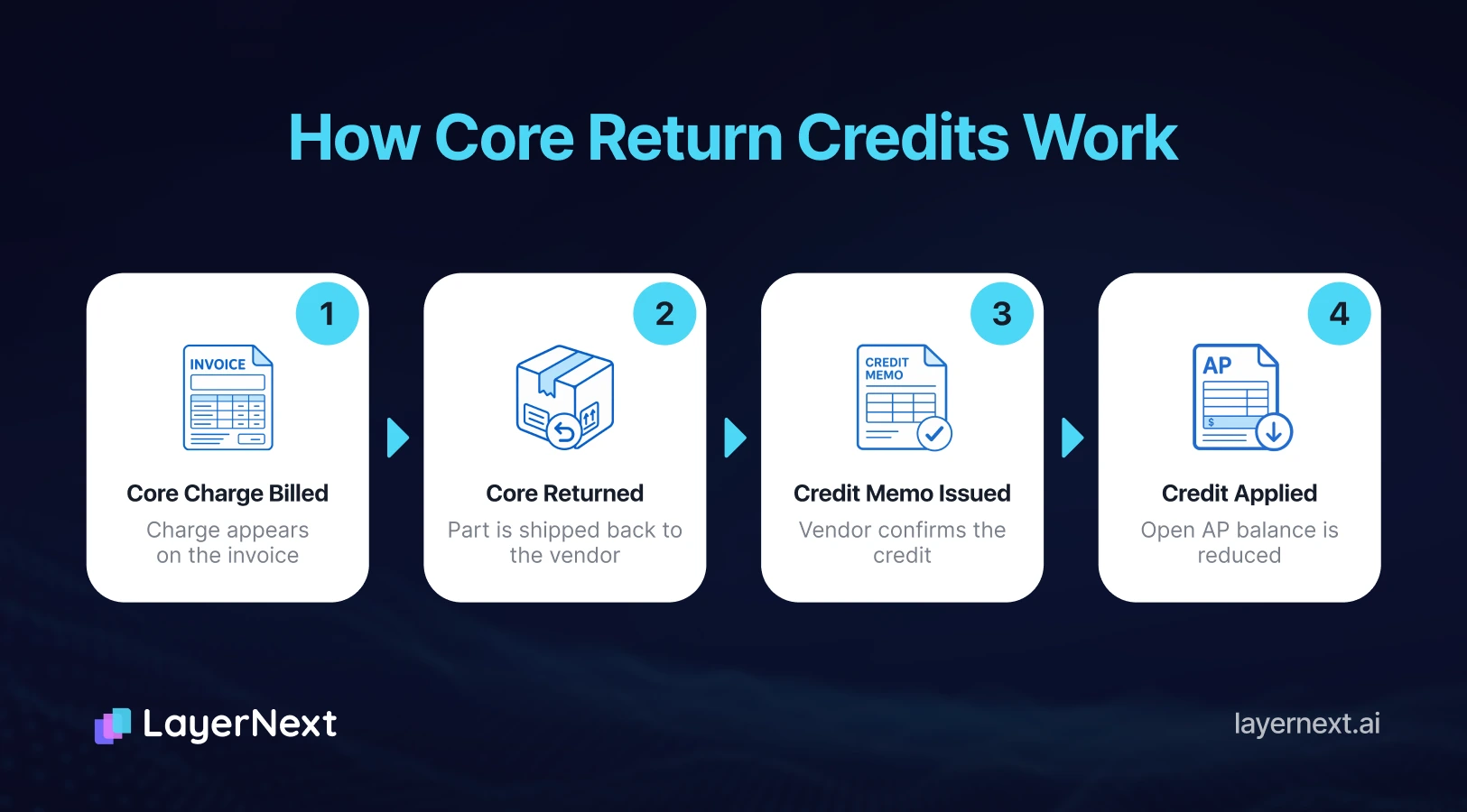
Core charge billed on invoice → Core physically returned to vendor → Vendor issues a credit memo → Credit applied to open AP
- The distributor buys a remanufactured part. The invoice includes the part price and a separate core charge.
- The old core gets shipped or carried back to the vendor, inside whatever return window the vendor sets.
- The vendor inspects the core, confirms it's the right part and within acceptable condition, and issues a credit memo for the core value.
- AP applies that credit memo against the original open core charge and closes it out.
Steps two and three are where the gap opens up. The physical return can happen in the warehouse days or weeks before the credit memo ever reaches AP, and if the core doesn't pass inspection, or the paperwork gets lost on the vendor's side, step three might not happen at all.
Debit Memo vs. Credit Memo: Which One Applies to a Core Return
A debit memo increases the amount a buyer owes. A credit memo reduces it. Both correct a balance after the fact, without touching the original invoice.
In a standard core return, the vendor issues the credit memo, since an accepted core reduces what the distributor owes. But debit memos show up in core transactions too. If a distributor sends back a core that turns out to be the wrong part, cracked, or missing a component the vendor requires for the rebuild, the vendor may issue a debit memo instead, billing the core charge back rather than refunding it.
Where Core Credits Land in the Books
When a core credit memo is applied, the typical entry looks like this:
Debit: Accounts Payable (reduces what's owed to the vendor) Credit: Purchase Returns and Allowances (or the core deposit asset account, if the original charge was capitalized separately)
Some distributors book the core charge to a dedicated core deposit asset account at the time of purchase rather than expensing it, in which case the credit memo clears that asset account instead of hitting purchase returns and allowances. Either treatment works as long as it's applied consistently. What actually matters for AP is narrower: the credit memo needs to be matched to the specific open core charge it's clearing, not just posted to a generic account and considered done.
Why Core Credit Memos Are Easy to Lose Track Of
A few failure patterns show up repeatedly:
- Timing lag
The physical return happens in the warehouse. The credit memo lands in AP's inbox weeks later, long after anyone remembers which invoice it ties back to.
- Amount mismatch
The vendor's credit doesn't match the original core charge exactly, a restocking fee gets netted out, a partial credit is issued for cosmetic damage, or there's a rounding difference.
- Bundled memos
One credit memo covers a dozen core returns across several invoices, so matching it to a single open item isn't a one-to-one lookup.
- No memo at all
The core ships back, but the vendor never issues anything, and the charge just sits open until someone happens to notice.
A Practical Matching Workflow for Core Return Credit Memos
- Flag the core charge as a separate open item the moment the invoice posts, tagged to the part number, quantity, and expected credit value.
- Log the date the physical core actually ships back to the vendor.
- When a credit memo arrives, match it to the open item by supplier, part number, and value, within a defined tolerance.
- Anything inside tolerance closes automatically. Anything outside tolerance goes to a person to review, rather than getting force matched or written off by default.
- Age open core charges the same way overdue invoices get aged, so returns that never get credited surface before they're forgotten entirely.
How LayerNext Automates Core Credit Memo Matching
The five-step manual workflow above is what LayerNext's AI agents run as part of a distributor's accounting software stack, minus the parts that make it slow or easy to drop.
The distinguishing piece is the matching logic itself. Tolerance rules are set per supplier in plain English by the AP team, not hardcoded once for every vendor, so a supplier known for netting out small restocking fees gets treated differently than one that never deviates from the exact core value. Anything outside that tolerance becomes a task in the portal instead of getting force matched or quietly written off.
For distributors on legacy, desktop ERPs like Epicor Eagle with no API, that posting step happens inside the ERP's own screens, the same way a person would, not through a data feed that doesn't exist.
What Happens If the Core Credit Memo Never Arrives?
If open core charges are tracked and aged, this becomes visible instead of buried in an account balance nobody reviews. Most vendors work within a defined credit window, commonly somewhere between 30 and 90 days depending on the vendor and the part category, so the first move is following up before that window closes. If the return was confirmed received but no memo shows up, escalate through the vendor rep directly rather than waiting.
Writing the charge off too early means eating the cost of a legitimate return. Leaving it open indefinitely just clutters the AP aging report and hides the pattern if it's happening repeatedly with one specific vendor, which is often the more useful thing to catch.
A Specific Next Step
If your team is tracking core credits in a spreadsheet next to the AP aging report, pull the ones that never matched cleanly, the mismatched amounts, the bundled memos, the ones still open past 90 days, and send them over. LayerNext's agents can show you live how many of those specific credit memos they can match, apply, and close out.
FAQ