Summary
Invoice volume spikes and permanent growth look the same in the first week. The instinct is to hire, but headcount added during a spike almost never gets removed once volume settles back down. This article gives a way to tell the two apart and a cost comparison for the five options that don't involve hiring.
- Diagnose before you act. Check cause, duration, supplier base, and invoice mix to tell a temporary spike from structural growth before you post a job.
- There are five options besides hiring. Overtime, redeploying cross-trained staff, temp or contract AP staff, BPO overflow, and automating the repetitive layer. Each has a different speed and cost.
- Triage is the free option most teams skip. Sorting invoices by risk (low-touch, standard, full review) costs nothing and improves throughput permanently.
- The break-even rule. Under about six to eight weeks, temp staff or overtime costs less. Past a quarter, or if the spike tends to repeat, a flat monthly automation fee costs less than options that scale with volume.
- Track four numbers to know if it's working. Cycle time, touchless processing rate, exception rate, and fully loaded cost per invoice.
- Hiring is the right call under three conditions. The growth is structural, a step requires a second set of human eyes for compliance reasons, or the added work is judgment rather than data entry. Not as the default first move.
Something changed in the last few weeks. The invoice count in your inbox, your ERP queue, or your shared drive went up, and it hasn't come back down. A new supplier agreement kicked in. The company opened a second location, or won a contract that doubled the paperwork from one division. Whatever caused it, the AP team is behind, month-end is going to be ugly, and the instinct that follows is almost automatic: open a req.
That instinct is worth interrogating for one specific reason. Headcount added during a spike almost never gets removed after it. The volume normalizes, the person stays, and the cost structure of the AP function quietly resets at a higher level for reasons nobody revisits.
What follows is the arithmetic and the decision path: how to size what you're actually dealing with, what each response costs, and the conditions under which hiring genuinely is the right answer.
How big does a spike have to be to matter?
There's a useful reference point for absolute scale. HighRadius, in its 2025 guide to high-volume AP, places the threshold for "high volume" processing at roughly 2,000 invoices a month, the point at which manual workflows tend to fail regardless of how good the team is. Below that number, a spike is more about pace than scale. Above it, the process itself is already near its structural limit, and a spike just finds the ceiling faster.
There's no clean industry number for what percentage increase counts as a "spike," and the sources that claim to have one don't agree closely enough to be worth repeating. Treat magnitude as a judgment call: if the increase is small enough to disappear inside normal month-to-month variation, seasonal supplier billing, a slightly larger order than usual, it's noise. If it's large enough that your team's existing capacity stops covering it, plan for it as a real spike, whatever the percentage happens to be.
What matters more than the percentage is what other companies in this exact situation actually did about it. Steve Goden, who runs AP at Forge Biologics, described the alternative to automating through a volume increase in blunt terms in a published MineralTree case study: "If we attempted to keep using our past approach, we would need at least two more AP headcount to manage the growing volume of invoices." At a different company, Simple Mills, a finance leader named McGannon credited the same category of tooling with absorbing "a nearly 50% increase in invoice volume without adding AP headcount." Different companies, different vendors, same shape of problem. That's the real question a spike puts in front of you: not how many percentage points it represents, but how many extra people it would otherwise cost you.
Is it a spike or a structural shift?
A temporary spike and permanent growth are indistinguishable in week one. They diverge quickly after that, and the response to each is different. Work through this before touching a job posting.
If most signals fall in the left column, this is a spike to absorb. If most fall right, the conversation with your CFO is about permanent capacity, and it should be, because temporary fixes applied to structural growth just delay a more expensive decision.
The invoice mix row deserves particular attention. More invoices from suppliers you already know is a throughput problem. New suppliers with unfamiliar formats and tax treatments is a complexity problem, and complexity is what actually breaks AP processes. A large volume increase from a handful of existing suppliers is far easier to absorb than a smaller increase spread across dozens of new ones.
Five ways to absorb a spike without adding headcount
Most content on this topic offers automation as the only alternative to hiring. In practice there are five levers, they are not mutually exclusive, and the right combination depends on how much time you have and whether the backlog is volume or complexity.
Overtime from the existing team
The fastest lever, and the one most teams reach for by default without pricing it. Sustained overtime across a small AP team adds up quickly per person per week, and it has a real ceiling: past three or four weeks, error rates climb and you start risking the staff you were trying to protect, which is a more expensive problem than the spike.
Redeploy and cross-train
Before looking outside the department, look at who already understands invoices, POs, and the ERP. AR staff, procurement coordinators, and junior accountants can usually absorb overflow invoice entry after a day of training, particularly for repeat suppliers whose formats they already recognize. This is the cheapest lever available and it leaves a cross-trained bench afterward, which is genuine residual value. The limit is that it borrows capacity from somewhere else in finance, so it holds for a few weeks before it starts showing up as a problem in collections or purchasing.
Temporary or contract AP staff
Finance and accounting staffing agencies can typically place a contract AP clerk within one to three weeks. Markups on temporary placements are commonly cited in the 30% to 75% range across staffing-industry pricing guides, covering employer payroll taxes, workers' compensation, benefits, and agency margin, so treat that as a planning range rather than a fixed rate to quote a CFO.
The cost most teams forget to budget is ramp. A contract clerk needs one to two weeks to learn suppliers, coding conventions, tolerance thresholds, and the approval chain before becoming net-productive, and that ramp consumes a senior person's time on your side. On a six-week spike, you are paying full rate for roughly four weeks of full productivity.
Outsourcing or BPO overflow
Straightforward, high-volume, low-complexity invoices can go to a business process outsourcer for the duration. This skips hiring and training entirely, which is its main advantage when the spike has already arrived.
The trade-off is control. A third party enters the approval chain and the audit trail, which matters if the invoices carry compliance requirements the outsourcer isn't structured to satisfy. It also tends to be the hardest option to unwind cleanly, because the process knowledge leaves with the vendor.
Triage the invoice queue
The most underrated lever, and the only one on this list that costs essentially nothing and improves the process permanently. Not every invoice needs the same scrutiny, and most AP functions treat all of them as though they do.
A workable segmentation:
- Low-touch
Under a set dollar threshold, from a known supplier with no exception history in the last twelve months, matched cleanly to a PO. Light review, batch approval. - Standard
Matched to a PO within tolerance, familiar supplier, above the low-touch threshold. Normal review. - Full review
No PO, new supplier, outside tolerance, or flagged by a prior exception. Full scrutiny, senior sign-off.
To size the opportunity, pull twelve months of invoice history, sort suppliers by invoice count, and calculate what share of total volume your top twenty suppliers represent. In most distribution and manufacturing environments that share is large, and it is almost entirely repeat, predictable, low-risk invoicing. Whatever that percentage turns out to be is roughly the share of your queue that does not need the treatment it is currently getting.
Automate the repetitive layer
The only lever that scales down as easily as it scales up, and the only one still working after the spike ends.
The mechanics matter more than the category. Automation that reads invoices wherever they arrive, by email, in a shared folder, from a supplier portal, and posts through an ERP's API where one exists or operates the ERP's own screens where it doesn't, covers a materially different range of environments than automation that requires an API. That distinction decides whether this lever is available at all. Plenty of mid-market ERPs, particularly older desktop installations like Epicor Eagle or QuickBooks Desktop, were never built with an API, which is exactly where automation projects historically stalled.

How LayerNext handles a volume spike without adding headcount
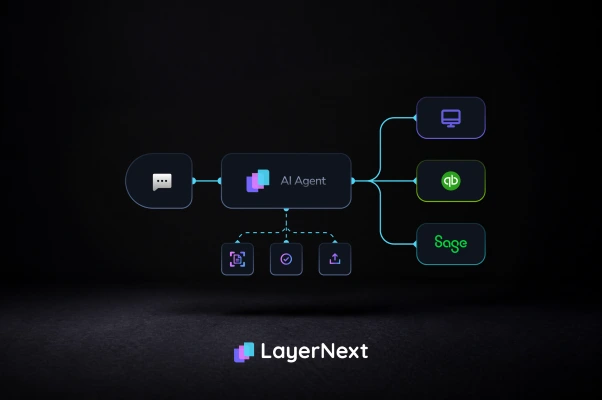
LayerNext works with an ERP's own API where the environment has one, and operates the ERP's own screens through computer-use automation where it doesn't, covering systems like Epicor Eagle, QuickBooks Desktop, and older Sage installs that predate APIs entirely. During a spike this matters because it removes the question that usually rules automation out before anyone checks whether it would help: whether the tool even supports the system in question.
Invoices get read from wherever they're actually arriving: a dedicated email inbox, a bot pulling from local machines and shared drives, cloud storage, a connected SQL database, or API-based systems like QuickBooks. A spike rarely arrives through one clean channel. It shows up as whatever mix of formats and sources the new volume happened to bring with it, and a tool that only accepts one input format just relocates the bottleneck instead of removing it.
New suppliers, who show up disproportionately during a spike caused by a new division or expanded territory, get handled through a business rules engine the finance team writes and edits themselves in plain English, rather than a request sitting in a development queue. A rule covering a new supplier's tax treatment or tolerance threshold can go live the same day it's needed.
Exceptions become named tasks routed to a person, tagged with the specific invoice and supplier, rather than a queue of documents that all look identical. During a spike specifically, that's the difference between review time going toward the invoices that actually need a judgment call and review time going toward re-keying the ones that don't.
LayerNext's own reported figures across its deployments: 90 to 165 hours saved per month per finance team, a 90% to 100% reduction in processing errors, and task accuracy above 95% on defined workflows, with deployment measured in weeks rather than months. Those are LayerNext's own numbers, not independently audited, worth treating as a vendor's stated outcome rather than a market benchmark.
What each option actually costs
A worked comparison, using numbers that can be checked: a fully loaded AP clerk salary of $50,000 to $60,000 a year, and the standard overtime and staffing-markup ranges already covered above.
Scenario
A spike requires roughly one additional full-time equivalent of AP capacity for one quarter, whether that estimate comes from a backlog count, a time study, or a gut check with the team. At the midpoint of the clerk salary range, $55,000 a year, that's about $26 an hour.
For a single, genuinely one-off quarter, renting capacity and hiring land in a similar range, and a permanent hire is actually the cheapest line item for that one quarter, because it's three months of salary against a full quarter of agency markup. That's precisely why hiring feels correct in the moment. It's also why it's the trap: the hire is cheap for one quarter and expensive for every quarter after, since the $55,000 doesn't stop at 90 days.
Automation is harder to slot into a single-quarter comparison because its cost behaves differently, not just at a different size. A permanent hire and a temp clerk both scale roughly with the size of the spike: twice the extra volume, close to twice the cost. A flat monthly fee generally doesn't move much whether it's covering last quarter's normal volume or this quarter's spike. That means the further a spike runs past what you budgeted for, the worse the economics of renting capacity look and the better the economics of a fixed-cost option look, without either number needing to be exact.
The break-even rule.
If the spike is genuinely one-off and under roughly six to eight weeks, temporary staff or overtime is the rational choice on cost alone. If it recurs annually, lasts more than about two quarters, or sits on top of a volume trend that was already climbing, the case shifts toward changing the cost structure rather than renting capacity against it, because overtime and temp staff produce nothing you still own once the spike passes, and a permanent hire's cost doesn't go back down when volume does.
How do you know it's working?
Coping and working look similar from the outside. Four numbers tell them apart. Published external benchmarks for these metrics vary too widely across sources to cite a specific target here without creating false precision, so track your own trend line rather than someone else's number.
Invoice cycle time.
Days from invoice receipt to approved and scheduled for payment. Measure the receipt-to-approval and approval-to-payment legs separately, because the delay usually lives in the approval leg and a blended number hides it. If this climbs week over week during a spike, the response isn't keeping pace, no matter how busy the team looks.
Touchless, or straight-through, processing rate.
The share of invoices moving from capture to approval with no human intervention. The direction matters more than the absolute number during a spike: if touchless rate falls as volume rises, whatever is absorbing the spike is absorbing it with human hours.
Exception rate.
Share of invoices falling outside normal processing. A rising exception rate during a spike almost always means new suppliers or formats are entering faster than your rules can handle them. The fix is the rule, not another reviewer.
Fully loaded cost per invoice.
Total AP processing cost divided by invoices processed in the same period. Fully loaded means labor for everyone who touches an invoice including approvers, software and licensing, payment execution, allocated overhead, and rework, the line most teams omit and the one that separates a real number from a flattering one. Run it quarterly rather than monthly so volume swings don't make it jump for reasons unrelated to efficiency, and segment PO-backed from non-PO invoices, since the non-PO population is typically far more expensive per invoice and that's where the improvement work belongs.
When headcount actually is the right call
Hiring is not wrong. It is wrong as an undiagnosed first move. It is right when specific conditions hold.
The growth is structural.
The diagnostic table points firmly right, the trend has held for two or more quarters, and this is the new baseline rather than a peak.
Segregation of duties requires a person. Some approval and reconciliation steps exist specifically because they need a second set of human eyes holding authority a system doesn't have. Automating or outsourcing those creates audit and fraud exposure that costs more than the headcount saved. If external auditors have opinions about who approves what, those opinions are a constraint, not an inefficiency
The new work is judgment, not keying.
Supplier negotiation, dispute resolution, and relationship management don't automate well. If the additional volume is concentrated there rather than in data entry, a person is the correct tool and the rest of this article doesn't apply.
Even under all three conditions, run the triage and automation levers first, since they change how many people are needed rather than only whether anyone is needed at all.
What if the spike doesn't go away?
Sometimes the honest answer only arrives a quarter or two later: what looked temporary has settled in as normal. When that happens, run the diagnostic again with the new data rather than defending the original read. Volume trend, supplier count, and invoice mix will all have moved, and they'll tell you plainly which column you're in now.
Two things matter at that point. First, make the headcount case on the trend line rather than on a bad month, because a CFO can approve the former and will reasonably resist the latter. Second, check whether the temporary fix in place scales into a permanent version or has to be torn out and rebuilt. Overtime and agency temps don't scale. Triage rules and automated workflows do, which is an argument for choosing those first even when a spike looks short.
Frequently Asked Questions